


New Distribution Capability (NDC) bookings carry a different data structure, settle through different channels, and unbundle fares in ways that legacy ticket-based systems were never built to handle. If your back office accounting still keys everything to BSP ticket numbers, NDC orders are quietly slipping through the cracks – and so is your margin.
NDC is no longer a “future trend” to plan for. It is already in your booking mix. According to IATA’s NDC tracker, NDC handled roughly 24% of indirect airline ticket sales globally in Q1 2026, up from about 11% in 2023, and ARC-settled NDC volumes in North America crossed one in five agency bookings in late 2025. The bookings are live. The real question is whether your back-office accounting has caught up.
This guide breaks down exactly where NDC trips up traditional travel agency finance, the warning signs of a back office that isn’t NDC-ready, and what a modern back office accounting system needs to do to keep your books accurate, reconciled, and audit-ready.
What Actually Changed With NDC (in Plain Accounting Terms)
NDC is an XML-based data transmission standard developed by IATA to let airlines distribute fares, ancillaries, and personalized offers directly to travel sellers – outside the decades-old EDIFACT messaging that powered the traditional GDS pipeline. The current generation is NDC 24.1, part of IATA’s wider “Offers and Orders” roadmap that aims to replace the PNR-and-ticket model entirely by the end of the decade.
For your front office, NDC means richer content, dynamic pricing, and à la carte ancillaries. For your finance team, it means three structural shifts that directly hit back office accounting:
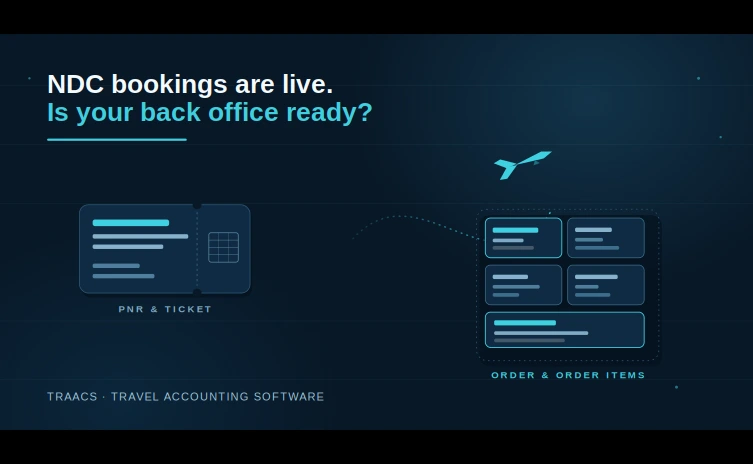
- The record changes from a ticket to an Order. Traditional accounting is built around a 13-digit ticket number and PNR. NDC replaces this with an Order ID and Order Items. A back office keyed to ticket numbers has nothing clean to match against.
- Settlement often moves outside BSP. Many NDC bookings settle directly with the airline or through an aggregator rather than through the IATA BSP. Your familiar BSP reconciliation file no longer tells the whole story.
- Fares are unbundled. Seats, bags, meals, and upgrades arrive as separate priced items, each needing its own accounting treatment, tax handling, and supplier reconciliation.
None of this is exotic. It simply doesn’t fit a travel accounting software workflow designed around BSP ticketing.
Why NDC Breaks Traditional Back Office Accounting
Here’s where the gap shows up in day-to-day travel agency accounting software operations.
1. The BSP Reconciliation Gap
For decades, ticket reconciliation was straightforward: match the BSP billing file to your sales ledger, flag the exceptions, and settle. NDC disrupts this because a large share of NDC bookings never appears in the BSP file. They settle via direct airline invoices, virtual cards, or aggregator statements.
If your back office accounting system only ingests BSP data, NDC sales show up as a reconciliation mismatch or worse, they don’t show up at all until a supplier invoice lands weeks later. The result is delayed closing, unmatched payments, and a growing pile of “unexplained” entries that finance teams chase manually.
2. Order vs. Ticket: A Data-Model Mismatch
An NDC Order can contain multiple passengers, multiple flight segments, and multiple ancillaries under a single Order ID, and that Order can be partially changed or refunded without a traditional reissue. Legacy backoffice accounting logic that assumes “one ticket = one line of revenue” can’t represent this cleanly.
When the data model doesn’t fit, teams improvise with manual journal entries and spreadsheets. Every manual touch is a chance for duplicate entries, mis-postings, and revenue that’s recognized in the wrong period.
3. Ancillaries That Hide Margin
NDC’s whole point is unbundled retailing. A single trip might generate a base fare, a paid seat, extra baggage, and a fare-bundle upgrade, each with different supplier terms, commissions, or markups.
If these ancillaries aren’t captured as discrete, accountable items, two things happen: you under-bill clients, and you lose visibility into which products actually make money. Strong back office accounting has to treat every ancillary as a first-class ledger object, not a footnote on a ticket.
4. Servicing, Refunds, and Exchanges Work Differently
In the Offers and Orders world, a change isn’t always a void-and-reissue. An Order can be re-shopped and re-priced, with residual value and penalties handled at the Order-Item level. Refund and exchange accounting that assumes EMD/MCO and ticket reissue logic will misstate what’s actually owed to (or by) the airline.
For a travel business, mishandled refunds are pure leakage – money that should be recovered but isn’t, because the travel agency accounting software couldn’t reconcile the servicing event.
5. Multi-Currency and Tax Complexity
NDC offers are frequently priced dynamically and across currencies, with taxes and carrier fees bundled inside the offer. Without automated multi-currency handling and gain/loss calculation, your back office is left reconciling foreign-currency settlements by hand, a slow, error-prone process that distorts profitability reporting.
The Readiness Gap Is Real – and Measurable
This isn’t a problem only the largest agencies face. Industry data shows the back office is the lagging link. A 2025 GBTA study found that 37% of corporate travel programs made zero NDC bookings, and 54% of travel managers said their TMC couldn’t adequately support NDC. The gap between airline NDC deployment and downstream readiness, including finance and reconciliation, is the defining operational challenge of this transition.
Translation: Airlines have shipped NDC. Distribution has adopted it. Back offices are where the accuracy is breaking.
7 Signs Your Back Office Accounting System Isn’t NDC-Ready
Use this as a quick self-audit. If you recognize three or more, your back office accounting needs attention:
- NDC sales appear as reconciliation exceptions instead of clean matches.
- Your team rekeys airline or aggregator data into the ledger by hand.
- Ancillaries (seats, bags, upgrades) aren’t itemized in invoices or reports.
- You can’t produce real-time profit per booking that includes NDC orders.
- Refunds and Order changes require manual journal corrections.
- BSP and non-BSP (direct/aggregator) settlements live in separate spreadsheets.
- Month-end close is slipping as NDC volume rises.
Each symptom maps back to the same root cause: a ticket-era back office accounting system trying to process Order-era transactions.
What a Modern, NDC-Ready Back Office Should Do
A genuinely NDC-ready travel accounting software platform doesn’t bolt NDC on as an afterthought. It treats GDS, LCC, and NDC bookings as equal citizens in one financial workflow. At a minimum, look for:
- Automatic booking capture across all channels. Every booking – GDS, LCC, and NDC should flow into accounting without re-entry, mapping the Order ID and Order Items into your ledger automatically. This is the foundation of reliable back office and real-time accounting.
- Order-aware ledger logic. The system must model an Order with multiple passengers, segments, and ancillaries and post the right entries when any part of that Order is changed, refunded, or re-priced.
- Unified, automated reconciliation. BSP, direct airline billing, aggregator statements, bank, and card settlements should reconcile in one place. Mid office and auto reconciliation that matches NDC settlements automatically eliminates the spreadsheet sprawl.
- Ancillary-level visibility. Every unbundled item should be priced, invoiced, and reported on, so you bill clients correctly and see true product profitability.
- Instant invoicing and real-time financials. Bookings should convert into invoices and journal entries on the spot, see front office and auto-invoicing feeding a live P&L and balance sheet instead of a batched month-end scramble.
- Multi-currency accounting with auto gain/loss. Dynamic, cross-currency NDC offers need automated revaluation, not manual conversion.
In short, the goal is straightforward: NDC bookings should be as boring to account for as any other sale.
How TRAACS Handles NDC in the Back Office
TRAACS is travel agency accounting software built specifically for B2B travel agencies, tour operators, and TMCs, and it’s designed for exactly this transition. The platform supports airline NDC alongside GDS and LCC bookings, so modern airline content flows into your operational and financial processes without breaking your books. You can see the unified GDS/LCC/NDC approach on the TRAACS integrations page.
In practice, that means NDC orders are captured automatically, converted into invoices and ledger entries instantly, and reconciled against BSP, supplier, bank, and card settlements through automated matching. Ancillaries are itemized, multi-currency is handled with automatic gain/loss, and finance teams get live P&L and balance-sheet visibility instead of waiting for batched reports. The outcome travel businesses report from this kind of automation is fewer manual entries, faster close, and far less revenue leakage from missed ancillaries and mishandled refunds.
That’s the difference between a back office that fears NDC growth and one that simply absorbs it.
Action Steps: Make Your Back Office NDC-Ready
If NDC is already in your booking mix (it is), here’s a practical sequence:
- Quantify your NDC exposure. Pull the share of bookings settling outside BSP. That number is your reconciliation risk.
- Audit the manual touchpoints. Every place a human rekeys airline data is a leakage and error point.
- Confirm Order-level support. Ask whether your back office accounting system can post correctly when an NDC Order is partially changed or refunded.
- Unify reconciliation. Bring BSP and non-BSP settlements into one automated workflow.
- Demand ancillary visibility. Make sure every unbundled item is invoiced and reported.
Get these right, and NDC stops being a finance headache and starts being a margin opportunity.
Frequently Asked Questions (FAQ)
NDC (New Distribution Capability) is an IATA XML-based standard that lets airlines distribute fares and ancillaries directly to travel sellers. In accounting terms, it replaces the ticket-and-PNR record with an Order ID and Order Items, and often settles outside the IATA BSP, which changes how reconciliation and ledger posting must work.
Because most legacy back office accounting systems are built around BSP ticket reconciliation. NDC orders use a different data model, settle through direct or aggregator channels, and unbundle fares into separate ancillary items – none of which a ticket-era system maps cleanly, forcing error-prone manual workarounds.
You reconcile NDC bookings by matching the airline or aggregator settlement (direct billing, virtual card, or aggregator statement) to the corresponding Order in your ledger, ideally through automated reconciliation that handles BSP and non-BSP channels in one place, rather than separate spreadsheets.
Yes. Modern travel accounting software such as TRAACS captures GDS, LCC, and NDC bookings in a single workflow, auto-generates invoices and journal entries, and reconciles all settlement types automatically, keeping financials accurate as your NDC volume grows.
NDC is not mandated by IATA, but adoption is accelerating, with airlines increasingly incentivizing NDC content and reserving certain fares for NDC channels. For most agencies, NDC bookings are already arriving – so the practical priority is making sure your back office accounting can process them correctly.
Conclusion
NDC bookings are live, growing, and structurally different from the ticketed sales your back office was built around. Left unaddressed, that mismatch shows up as reconciliation exceptions, manual journals, missed ancillaries, and a slower close. Addressed properly – with a back office accounting system that treats GDS, LCC, and NDC as one unified financial flow, NDC becomes just another well-accounted-for line of revenue.
Want to see how NDC bookings flow straight into reconciled, real-time accounts? Request a TRAACS demo and find out whether your back office is truly accounting for NDC correctly.


