


Travel agencies globally are increasingly turning to travel ERP software to streamline their operations, enhance customer experiences, and gain a competitive edge. This comprehensive guide explores how these advanced systems are revolutionizing the way travel businesses manage everything from bookings to accounting, with a special focus on automation.
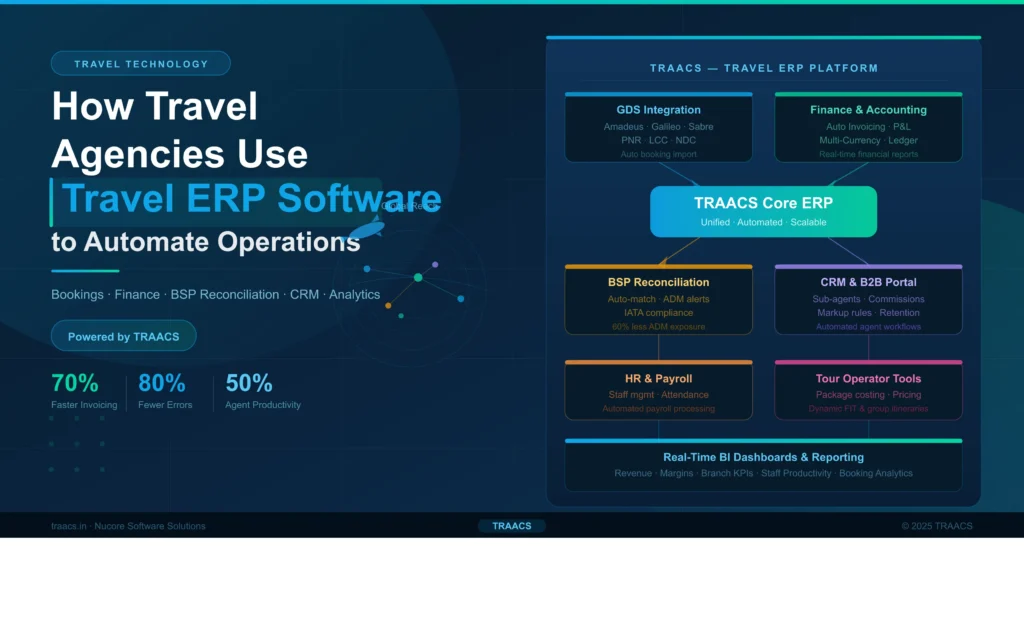
What Is Travel ERP Software? (And Why It Matters Now)
Travel ERP software is an enterprise resource planning platform specifically designed for the operational realities of travel businesses, tour operators, OTAs, DMCs, corporate travel management companies (TMCs), and retail travel agencies.
A general ERP (SAP, Oracle, NetSuite) handles finance and inventory well but lacks native support for GDS connectivity, PNR management, package costing, or dynamic pricing. An ERP for travel agency operations, by contrast, is built around these exact functions.
Core modules typically include:
- Reservations & Inventory Management
- CRM & Lead Management
- Finance, Billing & Multi-Currency Accounting
- Commission & Agent Payout Tracking
- Supplier & Vendor Management
- HR & Payroll
- BI Dashboards & Reporting
- B2B / B2C Booking Portals
The Global Shift Towards Automation in Travel
The travel sector, characterized by complex itineraries, diverse supplier networks, and fluctuating demands, presents unique operational challenges. Historically, many agencies relied on manual processes and disparate systems, leading to inefficiencies, errors, and increased operational costs. However, the advent of sophisticated ERP software for travel agency operations has ushered in an era of hyperautomation.
Modern ERP systems are designed to integrate various functions, providing a unified platform for managing critical business processes. This integration is crucial for travel agencies looking to automate tasks such as data entry, quote generation, invoicing, and reconciliation. The global ERP for tourism market is experiencing robust growth, driven by the increasing need for efficient resource management and streamlined operations.
The Global Adoption Landscape
Travel ERP adoption is accelerating globally, but the drivers and use cases vary significantly by region.
North America & Europe: Compliance and Consolidation
Large TMCs and leisure agencies in North America and Western Europe are primarily using ERP systems for travel agency financial consolidation and regulatory compliance. Multi-entity reporting, GDPR-compliant customer data management, and automated tax handling across multiple jurisdictions are key priorities. Many mid-market agencies in this region have replaced legacy systems (Tourplan, TravelBox) with cloud-native ERPs to reduce IT overhead.
Middle East & India: High-Volume B2B Automation
Travel agencies across the UAE, Saudi Arabia, and India — where B2B wholesale distribution is dominant — rely heavily on ERP platforms to manage sub-agent networks, automate markup rules, and process high volumes of bookings without proportional headcount growth. Agencies managing 500+ bookings per day frequently cite automated invoicing and commission reconciliation as their single biggest ROI driver.
Asia-Pacific: Package Costing and Dynamic Pricing
Tour operators in Southeast Asia, Australia, and Japan are using Travel ERP software to automate complex FIT and group package costing — connecting flights, hotels, transfers, and activities into dynamically priced quotes that update in real time as supplier costs change.
Key Areas Where Travel ERP Software Drives Automation
1. Booking and Reservation Management
At the core of any travel agency are bookings. A robust travel ERP system centralizes booking management by integrating with Global Distribution Systems (GDS) like Amadeus, Galileo, and Sabre, as well as Low-Cost Carriers (LCCs) and New Distribution Capability (NDC) platforms. This allows for seamless import, update, and tracking of bookings in one place, eliminating the need for manual re-entry and reducing the risk of errors.
2. Automated Financial Workflows and Accounting
One of the most significant benefits of travel ERP software is its ability to automate financial processes. This includes:
- Auto Accounting: Converting bookings into invoices, ledger entries, and financial reports instantly. This feature is vital for maintaining accurate financial records and providing real-time insights into profitability.
- Reconciliation: Automating the reconciliation of BSP (Billing and Settlement Plan) reports, supplier statements, and bank transactions. This significantly reduces the time and effort spent on manual reconciliations and can decrease ADM (Agency Debit Memo) exposure by up to 60%
- Multi-Currency Management: For agencies operating globally, handling multiple currencies is a complex task. ERP systems like TRAACS automatically manage multi-currency sales, settlements, and revaluation, addressing the challenges of fluctuating exchange rates and cross-border transactions
3. Operational Efficiency and Risk Management
Beyond bookings and finance, ERP for travel agency solutions extends automation to broader operational aspects. This includes managing credit limits, monitoring booking policies, and generating automated reports. Real-time dashboards provide insights into revenue, staff productivity, and overall operational performance, enabling smarter decision-making.
Documented Results: What Agencies Are Reporting
Based on documented outcomes from agencies that have deployed travel ERP platforms:
| Operational Area | Reported Improvement | Impact |
| Invoice Processing Time | Up to 70% faster | Finance Team |
| Booking Error Rate | Reduced by 60–80% | Operations |
| Agent Productivity | 30–50% increase | Sales Team |
| Customer Retention | +15–25% improvement | CRM / Marketing |
| Reporting & Insights | Real-time vs. weekly | Management |
How to Choose the Right ERP System for Your Travel Agency
Not every ERP system for travel agency use is equal. When evaluating platforms, focus on these critical criteria:
- Travel-specific architecture: Does it natively handle PNR imports, GDS connectivity, and package costing — or are these bolt-ons?
- Integration depth: Can it connect with your existing suppliers, payment gateways, and accounting software (QuickBooks, Tally, Xero)?
- B2B vs. B2C focus: Does it support your distribution model — direct consumer sales, agent networks, or both?
- Cloud vs. on-premise: Cloud-based ERP reduces IT infrastructure costs and enables remote access; critical for distributed teams.
- Scalability: Will the platform handle your booking volume as you grow without requiring re-implementation?
- Support & implementation: Choose vendors with documented travel industry expertise, not generic ERP consultants.
Common Implementation Challenges (And How Agencies Overcome Them)
The agencies that extract the most value from Travel ERP software are those that go in with realistic expectations. Common challenges include:
- Data Migration Complexity: Legacy booking data, customer records, and supplier contracts must be cleaned and migrated. Best practice is to conduct a full data audit 90 days before go-live.
- Staff Adoption: Agents accustomed to manual processes resist change. Successful agencies appoint internal ERP champions per department and invest in role-specific training rather than one-size-fits-all sessions.
- Over-Customization: Agencies that heavily customize core ERP modules during implementation face expensive upgrade cycles. Work with the standard functionality first, then assess gaps at the 6-month mark.
Beyond the Basics: Advanced Capabilities Agencies Are Unlocking
As agencies mature in their ERP journey, they increasingly leverage advanced capabilities that go beyond simple automation. Leading platforms now support:
- Travel agency back office software integration: Seamlessly connecting front-desk booking tools with back-office finance, HR, and reporting eliminating departmental silos.
- BSP reconciliation automation: Automatically matching Billing Settlement Plan (BSP) reports from IATA against internal booking records, catching discrepancies in minutes rather than days.
- Travel accounting software: Real-time P&L visibility across branches, currencies, and booking types, replacing end-of-month batch reporting with live financial dashboards.
- Travel agency management software for DMCs: Destination Management Companies are using ERP to manage ground services, local supplier contracts, and group itineraries alongside standard booking workflows.
- Tour operator software: Package costing engines that automatically reprice itineraries when supplier rates change, protecting margins without requiring manual rate audits.
- Corporate travel management system: TMCs managing corporate clients benefit from per-client reporting, policy compliance tracking, and spend analytics built directly into the ERP.
Conclusion
Travel ERP software is no longer a luxury but a necessity for travel agencies aiming for operational excellence and sustainable growth. By automating critical processes, providing real-time insights, and ensuring financial integrity, these systems enable agencies to focus on what they do best: creating unforgettable travel experiences. Solutions like TRAACS are at the forefront of this transformation, helping agencies worldwide to run more profitable, automated, and scalable businesses.
Frequently Asked Questions (FAQs)
Travel ERP software (Enterprise Resource Planning) is a comprehensive management system designed specifically for travel agencies and tour operators. It integrates various business functions like booking, accounting, finance, and operations into a single platform to automate processes and provide real-time insights.
ERP software for travel agency operations automates tasks such as booking management, invoicing, financial reconciliation (including BSP), multi-currency accounting, and reporting. This reduces manual effort, minimizes errors, and improves overall efficiency.
Benefits include reduced operational costs, improved accuracy, better financial management, real-time visibility into business performance, enhanced customer service, and increased scalability for growth.
Automated BSP (Billing and Settlement Plan) reconciliation is crucial for travel agencies as it streamlines the process of matching airline sales with payments, reduces the risk of ADMs (Agency Debit Memos), and ensures financial accuracy and compliance.
Yes, advanced travel ERP systems are equipped to handle multi-currency sales, settlements, and revaluation automatically, simplifying international operations and mitigating risks associated with currency fluctuations.


