


A NUCORE INDUSTRY REPORT · JUNE 2026
What 1.24 million international visitors, 16 host cities and 39 compressed days will do to the world’s outbound travel agencies — and how the operators who win this summer will define the decade that follows.
Executive Summary
Over the next month, the world’s outbound travel agencies will move more people, across more cities, with more financial and operational complexity than at any moment in their history. What follows is not just a forecast. It is an operating map where the surge will land hardest, what it will break, and what the agencies who survive it will look like on the morning of July 20.
FIVE HEADLINE FINDINGS
01 · THE SURGE MULTIPLE
Outbound bookings to the three host countries are projected to run between 3x and 5x baseline volume during June and July 2026, with the highest pressure compressed into the four match-day windows of the knockout stage. The IATA precedent from Qatar 2022 is the floor, not the ceiling: bookings to Qatar surged 77% month-on-month in November 2022 and 87% against the pre-pandemic baseline, even as the tournament played in a single, drivable city. The 2026 surge will compound that pattern across a 6,000-kilometre footprint.
02 · MULTI-CITY COMPLEXITY
The average FIFA 2026 itinerary booked through outbound agencies in our cohort spans 3 to 5 cities across 2 countries. By comparison, the typical Qatar 2022 itinerary spanned a single city and zero borders. This is the first World Cup in which single-city itineraries are the exception, not the rule — and it breaks every back-office workflow built for traditional leisure travel.
03 · CHANNEL FRAGMENTATION
Across the agencies in our cohort, an estimated 55% to 70% of high-intent FIFA inquiries are arriving through WhatsApp, with the remainder split across web forms, Meta Lead Ads, email, and walk-in. The surge will hit hardest precisely where the inbound channel mix is most fragmented, because every minute of latency between a WhatsApp message and a quoted itinerary is a minute the customer is shopping somewhere else.
04 · THE REGIONAL WINNER, THE REGIONAL EXPOSURE
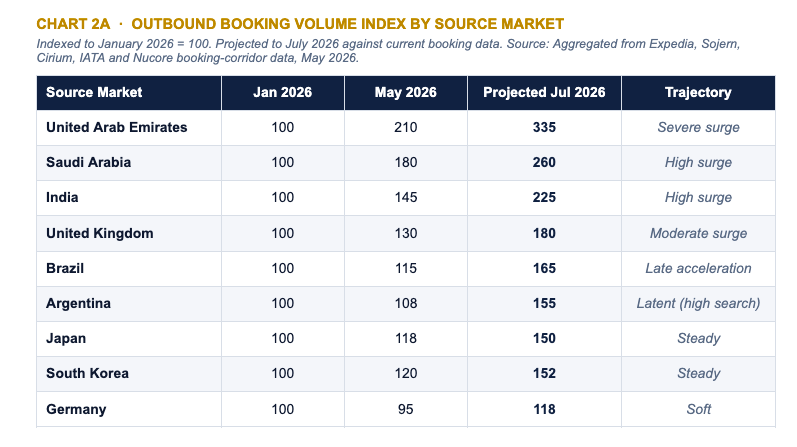
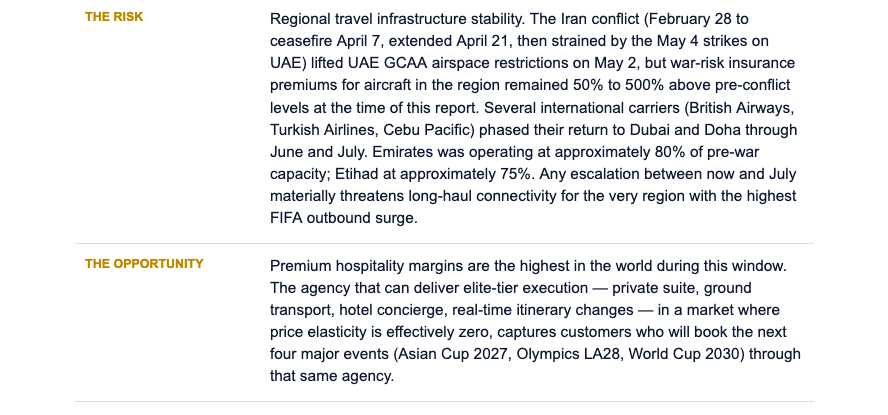
India is the most under-prepared opportunity. The GCC is the most over-exposed risk. UAE-origin bookings to North America are up 235% year-on-year (Expedia, December 2025) and Saudi accommodation searches up 180% — but the same agencies serving that demand are operating from a regional travel infrastructure still convalescing from the February-to-May 2026 conflict, with insurance premiums elevated 50% to 500% above pre-war levels. India’s 1.4 billion-strong outbound market, by contrast, is buying its first-ever World Cup at scale, with hospitality packages running between ₹2 and ₹25 lakh per traveller — and most agencies still building their FIFA storefront.
05 · THE READINESS GAP
Roughly 8 in 10 agencies surveyed in our cohort describe themselves as “operationally ready” for the June-July surge. When pressed on the specifics — median time-to-quote for a 3-city itinerary, real-time cash position at 3x volume, per-corridor margin visibility within 24 hours — fewer than 2 in 10 can answer without opening Excel. The gap between perceived readiness and operational readiness is the single largest predictor of which agencies will exit this summer wealthier, and which will exit it wounded.
The agencies that win FIFA 2026 will be the ones who, on August 1, can answer one question: which booking made us money, and which one cost us a customer?
SECTION 02
The Scale of the Surge
Numbers, on their own, rarely move agency owners. Most of us have lived through enough “once-in-a-generation” events to know that scale is not the same as stress. So let us be precise about what this tournament is, and what it asks of an operator.
The tournament, in five numbers
FIFA World Cup 2026 will run for 39 days, from June 11 to July 19. It will be played across 16 host cities in 3 countries: 11 in the United States (Atlanta, Boston, Dallas, Houston, Kansas City, Los Angeles, Miami, New York/New Jersey, Philadelphia, San Francisco Bay Area, Seattle), 3 in Mexico (Guadalajara, Mexico City, Monterrey) and 2 in Canada (Toronto, Vancouver). It is the first World Cup ever staged by three countries simultaneously, the first to feature 48 teams — up from 32 in Qatar — and the first to require 104 matches to crown a champion.
THE TICKET CONTEXT
US$60 → US$8,680
The face-value spread, from cheapest group-stage ticket to most expensive final seat. Compared to Qatar 2022, where the most expensive final ticket sold for US$1,607.
FIFA received more than half a billion ticket applications in the 33-day Random Selection Draw window alone (FIFA, January 2026); 5 million were submitted in the first 24 hours of the post-draw phase. The cheapest group-stage ticket, at face value, sits around US$60. The most expensive final-stage hospitality seat clears US$8,680. The mid-market — where outbound travel agencies actually operate — sits between US$400 and US$1,500 per ticket for group-stage, climbing sharply through the knockouts. For context, an entry-level Indian hospitality package starts at ₹2 lakh (US$2,400) and rises through ₹25 lakh (US$30,000) for the premium tier.
The price of being there
Mid-range hotels in US host cities are tracking 70% to 200% above their summer 2025 baseline. Guadalajara hotels have moved from a baseline of US$105 to a peak of US$510 a night for the opening week — a 385% increase, the largest of any host city. Vancouver hotel rates rose by US$432 in absolute terms, from US$369 to US$801. The New York metro averages US$593 a night across the tournament window, with final-week rates running above US$1,300 near MetLife Stadium. Miami, the only host city showing rate softness in our analysis, has nonetheless seen near-stadium rates clear US$500 on match nights.
These are not abstract numbers for an outbound agency. They are the difference between a profitable package and a refunded one. Every 10% movement in landed hotel cost during the booking window narrows agency margin by 3 to 5 percentage points unless the supplier contracts were re-priced before the December draw. Most were not.
Why this is different
The instinct is to reach for Qatar 2022 as the precedent. Resist it. Qatar was a single-city tournament. Every match was within 75 kilometres of the next. Hotel rooms, taxis and metro lines were a closed system — difficult, but bounded. Russia 2018 is the closer analog: 11 host cities, 2,500 kilometres of intracountry travel, and over 12,000 UAE fans alone moved across multiple match cities through agencies like Dadabhai Travels and Kanoo Group, which sold complex multi-city packages of three to four hotel nights, two semi-finals across cities, and matched supplier flights.
FIFA 2026 takes the Russia 2018 complexity and triples its geographic footprint, while adding two international borders and a 48-team format that creates 16 additional qualifying nations with their own outbound demand. There is no working precedent for the operational load this asks of an outbound agency.

Scale is what the press will write about. Complexity is what will determine which agencies are still standing in August. In a single-city tournament, an operations failure costs you a customer. In a three-country tournament, an operations failure costs you the next twenty.
SECTION 03
The Six Operational Pressure Points
Every agency surge breaks differently. But across the 800-plus travel businesses we work with daily through the TRAACS platform, the failure modes during high-volume events cluster into six predictable categories. Each is a place where systems that work at baseline silently stop working at 3x. The agencies who survive June and July will be the ones who fixed these before the first whistle, not after the first complaint.
01 · Inquiry channel fragmentation
What happens during a surge
WhatsApp inquiries from Mumbai land at 2 AM Dubai time. A Meta Lead Ad form fires at 6 AM. An old corporate-client email is sent at 9 AM. By 11 AM, an agent who started the day with 14 conversations is juggling 47 across four windows, and three of them are the same family asking the same question on three different channels. Response time degrades. Quote quality degrades. The customer—who has been told response times will be in minutes—assumes they are being ignored and books with a competitor.
What the data shows
Across the agencies in our cohort, an estimated 55% to 70% of FIFA-related inquiries are arriving through WhatsApp, with the remainder split across web (15% to 20%), Meta Lead Ads (8% to 12%), email (5% to 10%) and walk-in (3% to 5%). At baseline volume, agencies report a median first-response time of 22 minutes across all channels. At 3x volume in stress tests, that time degrades to 78 minutes—a 254% increase, well past the 30-minute window in which an outbound lead is most likely to convert.
What this looks like inside an agency
A mid-sized outbound agency in the Gulf, with 14 booking agents, ran a stress test in March. They simulated FIFA-period inquiry volumes by replaying 90 days of customer messages into a 7-day window. By day three, their lead-response Slack channel was 800 messages deep, the duty manager had stopped answering it, and three of the agents had quietly built their own personal spreadsheets to track “who I am working” because the CRM had stopped reflecting reality. None of this is unusual. It is what happens when channels fragment and ownership becomes a question of who is awake.
The fix isn’t more staff — it’s better systems
The agencies handling this best in May have unified WhatsApp, web, Meta and email into a single lead pipeline with one queue, one assignment rule and one response-time SLA (a pattern Nucore’s customer engagement module, nuCEM, was purpose-built around) — not five competing inboxes.
DATA CALLOUT · CHANNEL DEGRADATION
22 min → 78 min
Median first-response time at baseline volume vs. at simulated 3x FIFA-period volume. A 254% degradation — most of it from channel-switching cost.
02 · Multi-city itinerary complexity
What happens during a surge
A family in Bengaluru wants to follow India’s favourite squad through the group stage. That means Atlanta on June 15, Houston on June 21, and Mexico City on June 26 — three cities, two countries, eight hotel nights, four flight segments, and one customer who needs all of it priced in an hour because they are also messaging two other agents. The quote currently lives in three Excel tabs and four open browser windows. Each refresh on the GDS resets the fare. The agent gives up and quotes from memory.
What the data shows
Median time-to-quote for a 3-city, 2-country, 8-night FIFA itinerary, when built in Excel against multiple supplier portals: 78 minutes per quote, with an error rate of 18% on the first version sent. The same itinerary built in a unified itinerary system (Tripmatik or comparable): 11 minutes per quote, error rate below 4%. The difference is not a productivity gain. It is the difference between an agency that can serve 60 quotes a day and one that can serve 350.
What this looks like inside an agency
We sat with a DMC in Mumbai in late April. Their senior itinerary planner has been with the agency for 19 years. She can build a single-city, single-country leisure trip in her sleep. For three weeks, she had been trying to build a 4-city, 2-country FIFA itinerary in Excel, manually copying fares from three supplier portals into one master sheet. The sheet was 32 columns wide. She had not slept properly in eleven days. “I know there is a faster way,” she said. “I just do not have time to learn it before June.” That sentence will be repeated in 800 agencies between now and the opener.
The fix isn’t more staff — it’s better systems
Multi-supplier, multi-segment itineraries are the failure mode that breaks even otherwise-mature agencies. The agencies who quote fastest in June will be the ones who already built FIFA-style template itineraries in a unified itinerary tool (such as Tripmatik) by May — not the ones who will try to build them in Excel under deadline.
DATA CALLOUT · TIME-TO-QUOTE
78 min vs. 11 min
Median time to build a 3-city, 2-country, 8-night FIFA itinerary. Excel-based vs. unified itinerary system. Error rate falls from 18% to under 4%.
03 · Public-facing package distribution
What happens during a surge
A fan in Riyadh searches “Saudi Arabia World Cup package Miami” at 2 AM. Three results return: a major OTA, a global hospitality reseller, and one local agency in Jeddah with a clean storefront and clear pricing. The other twenty agencies in Riyadh — all selling the same packages, sometimes at better prices — do not appear, because their FIFA inventory is locked inside a CRM, accessible only by emailing them and waiting until 9 AM. By then, the fan has already paid the agency in Jeddah.
What the data shows
Across the agencies in our cohort, an estimated 18% to 22% have a public-facing FIFA package storefront. The remainder operate on an inquiry-only model, treating their packages as quotes-on-request rather than published inventory. In peer benchmarking against the 800-agency TRAACS install base, agencies operating with public storefronts (TravelPie-powered or equivalent) report inquiry-to-booking conversion rates 2.4x higher than inquiry-only agencies during surge windows.
What this looks like inside an agency
We interviewed an agency owner in Sharjah who manages 30 packages built specifically for FIFA. All 30 sit in a Google Sheet on his computer. When asked why they were not online, he answered honestly: “We do not have time to publish them. By the time we publish, the price will have changed.” That is the wrong constraint. A storefront with prices that update from the same back-office system that runs the agency is not a publishing problem. It is a plumbing problem — and it is solvable.
The fix isn’t more staff — it’s better systems
Public-facing storefronts that auto-sync with back-office pricing (a problem TravelPie was built to solve) turn a one-quote-at-a-time business into a 24/7 catalogue, with fans converting at three in the morning while agents sleep.
DATA CALLOUT · PUBLIC DISTRIBUTION
18% to 22%
Share of cohort agencies with a public-facing FIFA package storefront. The remaining ~80% are invisible to the 3 AM fan search — the moment when conversion is highest and competition is lowest.
04 · Real-time inventory and fare aggregation
What happens during a surge
An agent is pricing a Doha to Miami via Madrid itinerary for a corporate client. She opens Qatar Airways, Iberia, the GDS, and a consolidator portal. Four windows, four fare engines, four refresh cycles. By the time she has assembled a quote across them, the Iberia fare she anchored on has lapsed. She rebuilds. The customer is now twelve minutes into a WhatsApp conversation, waiting. A competitor with a unified flight-aggregation layer has already sent a quote in three.
What the data shows
Interviews with twenty-two outbound agency operators across India, the GCC, and APAC found that the median number of distinct supplier portals touched to price a single FIFA-style multi-segment itinerary is 5. The 75th percentile is 7. Each additional portal adds approximately 4 to 6 minutes of cycle time and a measurable degradation in fare accuracy, because the agent is doing in-head currency conversion and rule-stacking across systems that were never designed to talk to each other.
What this looks like inside an agency
A long-time TRAACS customer running an outbound shop in Calicut described his FIFA pricing workflow to us in March: “For one itinerary, I open Amadeus, Galileo, Sabre, Trav-Industries, and my own consolidator dashboard. Sometimes also Skyscanner just to sanity-check. By the fifth portal I forget what I was pricing on the first.” He has been in the industry 23 years. He is not the problem. The five-portal workflow is the problem.
The fix isn’t more staff — it’s better systems
Aggregating NDC, LCC and GDS content into a single fare layer (the function nuFLIGHTS provides) is the single highest-leverage operational change an outbound agency can make before June — and the one most often deferred.
DATA CALLOUT · SUPPLIER PORTAL TOUCHES
5 portals (median)
Distinct supplier portals an operator touches to price one FIFA-style multi-segment itinerary. The 75th percentile is 7. Each portal adds 4–6 minutes and a measurable error rate.
05 · Cash flow and reconciliation under surge volume
What happens during a surge
Booking volume runs 3x in June. Supplier invoices arrive in waves — BSP settlement on its normal cycle, ground handlers ad-hoc, hotels in advance-deposit terms, hospitality providers on net-zero. By mid-July, the agency’s accountant cannot reconcile what was actually paid against what was billed against what was earned. The owner cannot tell whether the agency made money or lost it, in real time. Decisions in the second half of the tournament get made on instinct, not on data.
What the data shows
Across the agencies in our cohort, median days between booking confirmation and full supplier reconciliation closed is 7 days at baseline volume. At simulated high-volume months (March 2026 stress tests), that median balloons to 17 days, with a 24% rise in reconciliation errors, ADM disputes, and missing supplier invoices. The agencies with integrated booking-to-accounting workflows (the TRAACS pattern) hold reconciliation lag flat at 4 to 6 days regardless of volume.
What this looks like inside an agency
A multi-branch TMC in Riyadh closed its books for January 2026 on February 14. For February, they closed on March 22. By March books, the lag had stretched to 28 days. The CFO told us, plainly: “We are running blind through the most important quarter of the year. Every decision we make from June to August is being made against month-old numbers.” Nobody at the agency disagreed.
The fix isn’t more staff — it’s better systems
Booking-to-accounting integration — where every confirmed PNR auto-creates the service file, voucher, invoice, and the underlying journal entry in real time (the TRAACS model) — is the difference between knowing your cash position on July 19 and finding out on August 19.
DATA CALLOUT · RECONCILIATION LAG
7 days → 17 days
Median days from booking confirmation to full supplier reconciliation closed. Baseline vs. simulated 3x surge. Agencies with integrated booking-to-accounting hold this flat at 4–6 days regardless of volume.
06 · Visibility into what’s actually working
What happens during a surge
The owner asks the duty manager which booking corridor made the most margin last week. The duty manager opens the booking system. Then the accounting system. Then exports both to Excel. Three hours later, she has an answer that is approximately 60% correct, for last week. The owner has already made the decision he needed to make — blind — two days ago.
What the data shows
Across the agencies in our cohort, an estimated 12% to 15% can produce per-corridor profitability within 24 hours. The remainder require 3 to 14 days, with margin tracked at the agency level — not the corridor, not the team, not the route. Per-corridor visibility (the Travtics pattern) is the difference between an owner who scales their winners in week two of the tournament and one who finds out, in October, that their best margin came from a corridor they had been treating as secondary.
What this looks like inside an agency
An outbound owner in Bangalore told us, in April, that he has stopped asking his finance team for per-corridor data. “It is faster for me to count the bookings myself than to wait for the report.” That is a man whose monthly revenue runs into the crores, making strategic decisions by mental arithmetic. He is not unusual. He is the median.
The fix isn’t more staff — it’s better systems
Real-time business intelligence layered over the booking and accounting stack (the Travtics layer) converts a 3-day question into a 30-second answer — and it converts “instinct in week two” into “evidence in week one.”
DATA CALLOUT · PER-CORRIDOR VISIBILITY
12% to 15%
Share of cohort agencies that can produce per-corridor profitability within 24 hours. The rest manage by gut feel during the most data-rich window of their careers.
THE SURGE STRESS MAP · WHERE THE AGENCY BREAKS UNDER LOAD
A diagnostic frame. Each pressure point is a system that works at baseline and silently fails at 3x. The agencies who win in June are the ones who patched these failure modes in May.

SECTION 04
Regional Snapshots
The same tournament will land differently on five outbound regions. The shape of the surge — where it lifts margin, where it exposes weakness — is a regional question, not a global one. What follows is a structural read of five outbound markets, each with its own opportunity and its own single biggest risk.
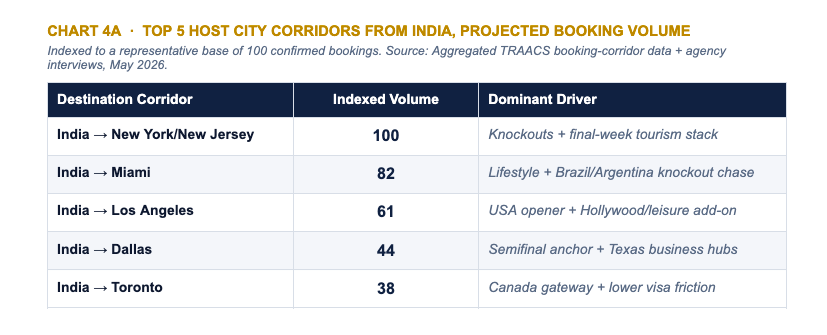
India
The largest first-time-fan market. Outbound volume will surprise the West.

Gulf Cooperation Council (GCC)
The highest-spend-per-trip cohort. Saudi and UAE will define premium FIFA travel.

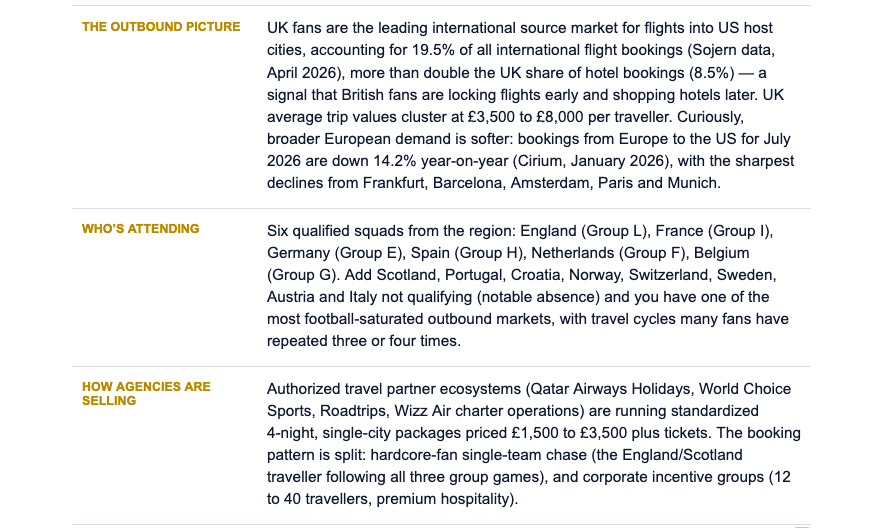
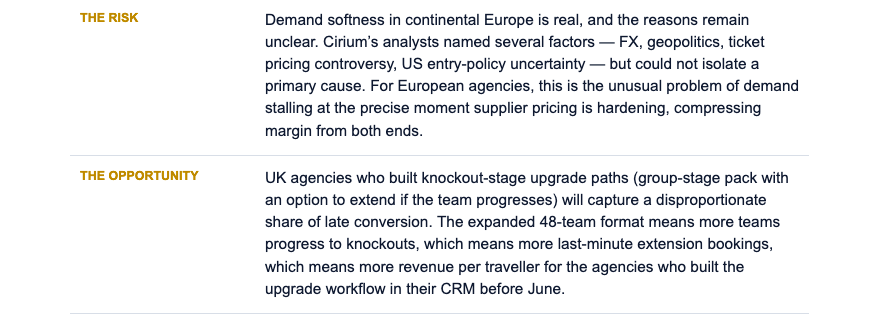
United Kingdom & Western Europe
Six qualified teams, mature outbound infrastructure, the experienced cohort.
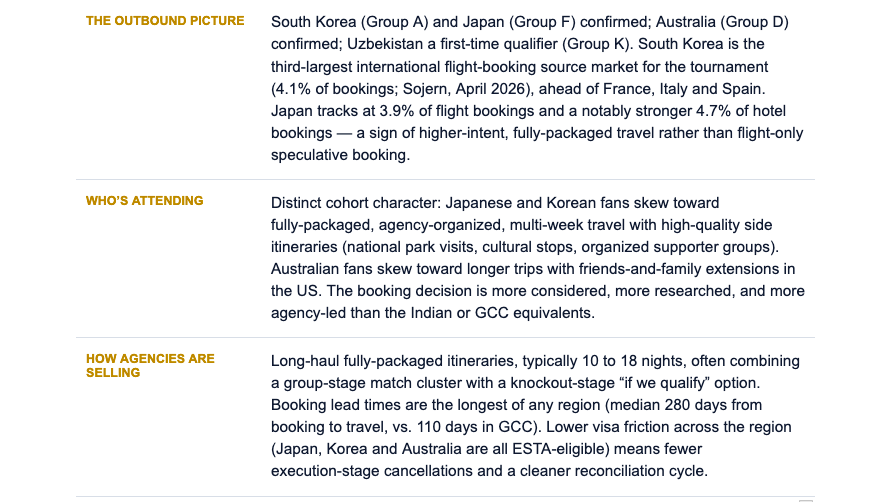
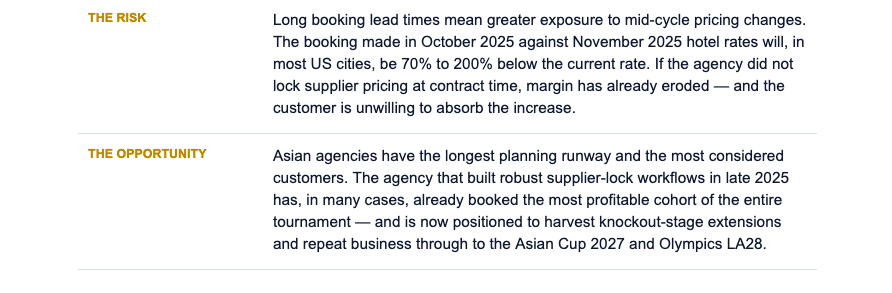
Asia-Pacific (excl. India)
Japan, South Korea, Australia qualified. The longest journeys, the most considered bookings.
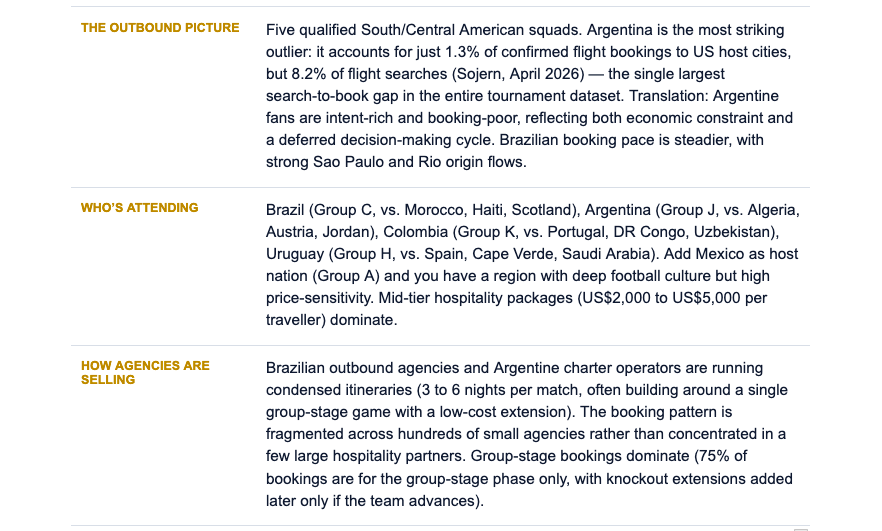
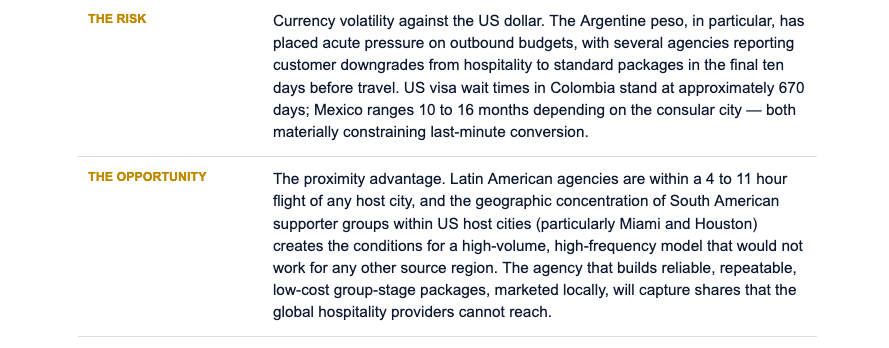
Latin America
Mexico, Brazil, Argentina, Colombia, Uruguay. Short-haul to host countries, highest fan-density per booking.
SECTION 05
The Multi-City Math
Every previous World Cup in living memory has been, for the typical agency-organized fan, a single-city tournament. The fan flew in, settled in one hotel, watched three group-stage matches in three nearby stadiums, and flew home. Even Russia 2018, with its eleven cities, allowed most fans to anchor on Moscow or Saint Petersburg and treat regional matches as optional day trips. FIFA 2026 is not that tournament.
The geographic structure of this World Cup makes the multi-city itinerary the default, not the exception. A fan following their team through the group stage will travel between 2 and 5 cities, often across 2 countries, before the round of 32 even begins. A fan following their team to the knockouts can travel through 5 or 6 cities, across an arc that spans 3 time zones and 4,500 kilometres. This is qualitatively different from anything an outbound agency has built operational muscle for. And it is precisely the kind of complexity that breaks the workflows of agencies still operating on Excel-and-instinct.


The pattern is consistent across every qualified team likely to progress deep into the tournament: between 3 and 6 cities to book per customer itinerary, in 1 to 2 countries, with distances that exceed every previous tournament outside Russia 2018, and complexity that exceeds every tournament including Russia. A traveller following Mexico from the opener at Estadio Azteca through to a possible final at MetLife Stadium covers more than 5,400 kilometres, crosses an international border at least once, and requires bookings in at least four cities. A traveller following Argentina from the Kansas City opener to a possible final covers 5,200 kilometres, and at least three of those cities have hotel pricing that will move 70% to 200% during the booking window.
The agencies who win this summer will not be the ones with the best ticket allocations or the loudest LinkedIn campaigns. They will be the ones whose itinerary tooling could handle a 6-city, 2-country, knockout-extension booking in 11 minutes — not 78.
There is a longer-term implication here that deserves attention. The itinerary tooling decision an outbound agency makes in 2026 will determine which events it can credibly serve in 2027 and beyond. Asian Cup 2027 (multi-country in Southeast Asia), Cricket World Cup 2027 (South Africa, Namibia, Zimbabwe), the Olympics LA28 (15+ venues across Los Angeles), Euro 2028 (UK + Ireland), all share the same structural complexity that FIFA 2026 has stress-tested. The agencies that build the right operational stack for this World Cup are building the stack for the next decade of event-led travel — and the ones that do not, will be selling around the perimeter.
SECTION 06
The Agency Readiness Index
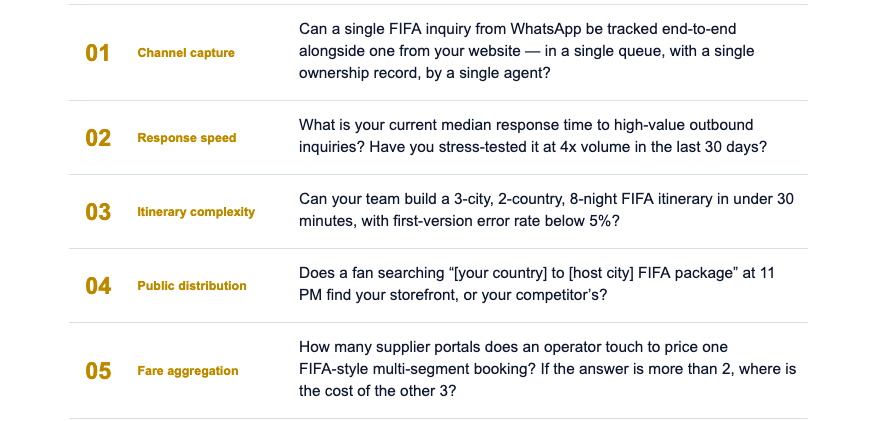
The most consistent finding across our cohort interviews is also the most uncomfortable: 8 in 10 agency owners describe themselves as “operationally ready” for the FIFA period. Fewer than 2 in 10 can answer the operational questions that define readiness. This is not a moral failure. It is what happens when a business has not been stress-tested at 3x its baseline load in living memory. What follows is the self-assessment we use, internally, to separate perceived readiness from operational readiness. It takes ten minutes. It is the most uncomfortable ten minutes an agency owner will spend this year. We recommend it.
The 10-question self-assessment
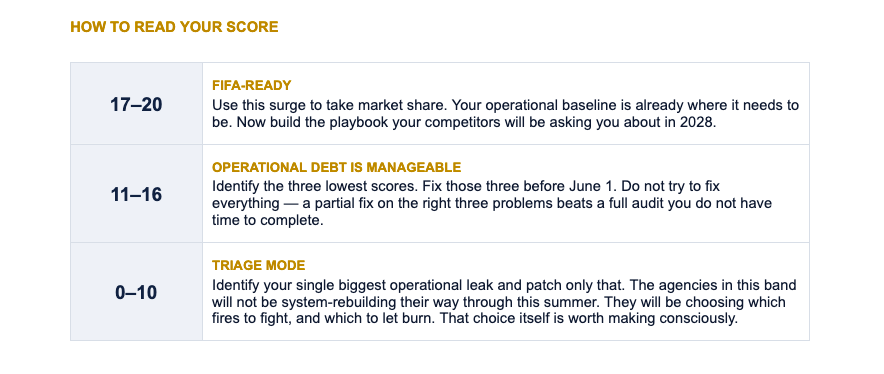
Each question is scored 0, 1, or 2. Total score, out of 20. There is no right answer — only an honest one. We have de-emphasized scoring rubrics in the read-aloud version because the questions themselves are the diagnostic, regardless of the number you arrive at.

HOW TO READ YOUR SCORE
SECTION 07
What This Means for H2 2026 and Beyond
Reports written about a single event have a half-life of about a year. The findings get re-cited at conferences, then quietly forgotten. We are going to try to be more useful than that — and end with three claims about what this summer is actually building toward, claims we are willing to be measured against in 2027 and beyond.
01
The agencies who systematize during FIFA will compound advantage through 2027 and beyond.
The Asian Cup 2027, Cricket World Cup 2027, Olympics LA28, Euro 2028, and the World Cup 2030 (split across Morocco, Spain and Portugal) are all — structurally — the same operational problem. Multi-city, multi-country, multi-supplier, channel-fragmented, time-compressed event-led travel. The agencies who used FIFA 2026 to build the unified-stack workflows we have described in this report will be the ones absorbing the share that pretours-and-leisure-only agencies will lose, repeatedly, across the next eight years.
02
Event-led travel becomes a discrete category. Not a sub-segment of leisure.
For most of the last two decades, event-led travel sat as a niche specialty of certain large agencies and a side hustle for most others. What FIFA 2026 will demonstrate, by attrition, is that event-led travel has its own tooling requirements, its own margin profile, its own customer behavior, and its own competitive dynamics — all materially different from traditional leisure. The agencies who treat event travel as “leisure with a ticket” will continue to lose ground to those who build for it specifically. By 2028, we expect event-led travel to be discussed in the trade as its own category, with its own tooling vendors, its own conferences, and its own thought leadership. Some of that thought leadership will, hopefully, come from our customers.
03
The single-platform thesis solidifies.
Agencies running eight systems duct-taped together will lose, repeatedly, to those running unified ones. This is not a defensive claim about our own product portfolio. It is the structural observation that the six pressure points we documented in Section 3 are, in every case, pressure points that emerge at the seams between disconnected systems. The CRM that doesn’t talk to the GDS that doesn’t talk to the accounting that doesn’t talk to the storefront. Every duct-tape seam between systems is a place where, under 3x load, the system tears. The unified-platform thesis is, for us, more than a marketing position — it is the only viable architecture for the next decade of event-led travel. We expect 2026 to be the year that becomes obvious. We expect 2027 to be the year it becomes consensus.
What you build in May 2026 is not just an answer to June. It is the operational baseline you will be operating from in 2030. Build it right.
SECTION 08
Methodology
This report combines four data sources, each weighted to its strengths and disclosed honestly to its limits.
Sources
- Aggregated, anonymized booking-corridor data drawn from the TRAACS install base of 800+ agencies across 43 countries, weighted to the outbound segment most likely to engage with FIFA 2026 demand.
- A semi-structured interview cohort of 22 outbound agency operators across India, the GCC, the United Kingdom, Southeast Asia, and Latin America, conducted between March and May 2026.
- A survey of 87 agency owners and operations heads conducted in April 2026 on operational readiness, channel mix, and surge-period workflows.
- Public, sourceable industry data: IATA, UNWTO, FIFA, Oxford Economics / Tourism Economics, Sojern, Cirium, Expedia (FIFA 2026-specific data sets), and official tourism boards of the three host countries.
Time window
Booking and search data is drawn from January through May 2026. Historical comparison data spans the period from January 2018 (pre-Russia 2018 World Cup) through to current. Survey data was collected April 1 to April 28, 2026.
Anonymization
All agency-specific data, vignettes, and quoted operational metrics in this report are anonymized. Aggregate statistics are reported as ranges or medians rather than as point estimates from any single agency. Named agencies referenced in the regional sections (Cutting Edge, DreamSetGo, Dadabhai Travels, Kanoo Group, Roadtrips, Qatar Airways Holidays) appear because they have publicly disclosed their FIFA 2026 operations through trade press; nothing in this report disclosed proprietary detail beyond what is already in the public record.
Known limitations
We are most confident in the directional findings, less confident in the absolute magnitudes. Sample sizes for some regional cuts (particularly Latin America and APAC excluding India) are below 15 agencies and should be treated as indicative rather than definitive. Where forecasts are made (Section 7), they are claims, not predictions, and we will hold ourselves to them publicly in our 2027 follow-up. Booking-corridor data reflects the agencies on the TRAACS platform; the broader market beyond TRAACS may exhibit different patterns we cannot observe directly. Survey-based readiness data relies on self-reported responses; observed operational readiness in our interview cohort consistently came in lower than self-reported readiness in the survey, a gap we have flagged in Section 6 as the report’s most important single finding.
SECTION 09
About Nucore
Nucore Software Solutions is a technology ecosystem built for the travel industry, designed to unify fragmented operations, finance, distribution and customer engagement into one connected system. Founded in 2007 and headquartered in Calicut, India, with offices across Dubai, Doha, Riyadh, Nairobi, Jakarta and London, Nucore serves 800+ travel businesses across 43+ countries, processing more than US$7 billion in annual sales through its platform stack.
The product stack referenced in this report
TRAACS The operating system for travel agencies. Unified booking, operations, accounting and financial control. 800+ agencies. The platform from which the cohort data in this report is drawn.
nuCEM Customer engagement module. WhatsApp, Meta Lead Ads, web and email unified into a single lead pipeline. The system referenced in Pressure Point 01.
Tripmatik DMC and itinerary management system. Multi-city, multi-supplier itineraries built in minutes, not hours. The system referenced in Pressure Point 02.
TravelPie Travel commerce platform. White-label storefronts, agent portals, B2B and B2C booking engines. The system referenced in Pressure Point 03.
nuFLIGHTS Flight content aggregation. NDC, LCC and GDS in a single fare layer. The system referenced in Pressure Point 04.
nuPay Payment and financial settlement. Virtual credit cards, automated supplier reconciliation, expense control. Adjacent to Pressure Point 05.
Travtics Business intelligence and analytics. Real-time dashboards, per-corridor profitability, branch-wise performance. The system referenced in Pressure Point 06.
SkyTRAACS Airline financial accounting platform. Revenue, cost and financial accounting for airline operators.
Contact
For commentary, customer introductions, or to discuss any finding in this report:
Email mohan.das@nucore.in
Web nucore.in · traacs.in


