


The travel industry has changed more in the last three years than in the previous decade. Booking volumes are surging, GDS integrations have grown more complex, corporate travel compliance requirements have tightened, and client expectations – driven by instant, app-like experiences are at an all-time high.
Yet many travel agencies are still running their operations on travel agency management software that was built for a different era. Spreadsheets patched together with half-automated exports. Accounting systems that don’t talk to the front office. Reconciliation workflows that eat up entire afternoons.
The cost isn’t just inefficiency. Outdated travel management software directly impacts your revenue, your client retention, and your ability to grow. According to industry benchmarks, agencies using fragmented tools spend up to 35% more staff time on administrative work compared to agencies on modern, integrated platforms.
So how do you know if your current system is holding you back? Here are the 10 most telling signs and what to do about each one.
- Your Reconciliation Is Still Manual (or Partially Manual)
Reconciliation is the heartbeat of a travel agency’s financial health and it’s also one of the biggest time sinks in the industry. If your team is still matching GDS booking records against supplier invoices and BSP statements by hand, that’s a clear signal your current travel agency management software isn’t doing its job.
Manual reconciliation isn’t just slow – it’s error-prone. Even experienced finance teams average a 1–2% error rate on manual matching, which on high-volume operations can represent thousands of dollars in missed recoveries or overpayments each month.
What modern software does instead: Platforms like TRAACS automate the entire reconciliation cycle – matching booking data, supplier statements, and BSP/ARC reports automatically, flagging exceptions for human review rather than requiring humans to do the matching. The result is faster close cycles, fewer errors, and finance staff that can actually focus on analysis rather than data entry.
- Booking Data and Accounting Live in Separate Systems
This is the most common structural problem in mid-size travel agencies: the front office uses one system for bookings and the accounting team uses a completely separate tool — often a generic accounting package like Tally, QuickBooks, or even spreadsheets for financials.
The result? Every booking generates a manual handoff. Staff re-enter data from the booking system into the accounting system. Discrepancies accumulate. Month-end becomes a painful exercise in reconciling two systems that were never designed to talk to each other.
Truly effective travel management software eliminates this gap. When a booking is created in the front office, it should automatically trigger the corresponding accounting entries – no manual exports, no re-entry, no lag. This tight integration between operations and finance is the single biggest productivity unlock for growing agencies.
- You Can’t Get a Real-Time Financial Report on Demand
When a CEO or CFO asks, “How are we performing this month?” – how long does it take your team to answer? If the honest answer is “a few hours” or “we need to run the numbers,” your travel agency management software has a visibility problem.
Modern travel businesses move fast. Client credit limits, supplier exposure, and cash flow need to be understood at a moment’s notice – not at the end of a manual reporting cycle.
Advanced travel management platforms offer live dashboards that surface key financial metrics as transactions happen. Booking-level profitability, outstanding receivables, supplier payables, and consolidated MIS reports should be available at a click – not a request that takes your finance team half a day to assemble.
Note: Agencies without real-time financial visibility are statistically more likely to overextend client credit, miss supplier payment deadlines, and underestimate exposure to currency fluctuations.
- Your Team Is Re-Entering the Same Data Multiple Times
Count the number of times a single booking is typed, copied, or pasted across your systems from initial enquiry to final invoice. For many agencies running fragmented travel agency management software, that number is between three and six.
Each re-entry is a multiplication of error risk, processing time, and operational cost. It also burns out your best staff, skilled travel consultants and finance officers, spending their days on data entry instead of selling, servicing clients, and driving growth.
- Booking details entered into the GDS
- Re-entered into a CRM or mid-office tool
- Copied into an invoice or billing system
- Manually posted into the accounting ledger
- Exported again for management reports
A unified travel management platform captures data once – at the point of booking and automatically distributes it to every downstream process. This “enter once, use everywhere” approach is the standard in modern travel agency management software, yet many agencies are still years behind it.
- You’re Losing Clients Due to Follow-Up Failures
Travel is a relationship business. Corporate clients, repeat leisure travellers, and MICE buyers don’t switch agencies because of price alone; they leave because they feel forgotten. If your CRM is a spreadsheet, a generic contact manager, or a collection of email threads, you’re losing business you don’t even know about.
Strong travel management software includes purpose-built CRM functionality designed for the travel context: automated follow-ups on enquiries, trip anniversary reminders, renewal prompts for corporate travel accounts, and sales pipeline tracking that gives managers visibility into every opportunity in the funnel.
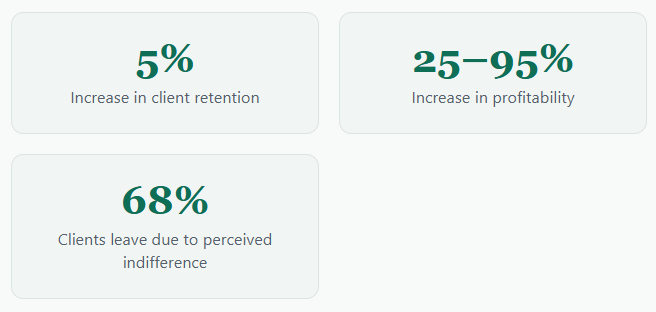
The business case is stark: Increasing client retention by just 5% can increase agency profitability by 25–95%, according to widely cited customer relationship research. Yet most agency CRM tools in 2026 still offer nothing more than contact storage and a notes field.
- Multi-Currency Transactions Are a Headache
For B2B travel agencies operating across multiple markets or serving corporate clients with international travel programmes, multi-currency management is not optional. Yet many older travel agency management software platforms treat it as an afterthought: a bolt-on with limited automation, manual exchange rate updates, and reconciliation that requires constant human intervention.
Real-world problems that arise from poor multi-currency handling include:
- Incorrect revenue recognition due to stale exchange rates
- Supplier payments processed at the wrong amounts
- Client invoices showing inconsistent currency conversions
- Month-end forex revaluation done entirely by hand
Modern travel management software handles multi-currency sales, supplier settlements, and revaluation automatically – with live exchange rate feeds, currency-specific ledger accounts, and consolidated reporting across all currencies. This alone eliminates hours of month-end finance work for international agencies.
- Your Software Can’t Scale With Your Business
When you hired your 5th employee, your current software handled it fine. At 15, it started showing cracks. At 30 or when you opened a second branch, or onboarded a major corporate account, it buckled. This is the classic scaling problem with entry-level or legacy travel agency management software.
Signs that your platform doesn’t scale:
- System slowdowns during peak booking periods
- No multi-branch or multi-entity support
- User permission controls are too basic for growing teams
- No API connections to add new GDS or supplier systems
- Licensing that becomes prohibitively expensive as users increase
Growing agencies need travel agency management software architected for scale from day one with role-based access controls, multi-branch consolidation, multi-entity accounting, and the API infrastructure to connect to new tools and platforms as the business evolves. Building your growth plan around software that tops out at your current size is one of the most expensive mistakes a travel agency can make.
- Compliance and VAT Reporting Require Manual Work
Tax compliance for travel agencies is notoriously complex. VAT on travel services, the Tour Operators’ Margin Scheme (TOMS), GST in India, VAT in the GCC, the rules vary by market, by product type, and by the structure of each transaction. If your current software doesn’t automate these calculations, your finance team is spending significant hours ensuring compliance, and your auditors are probably finding errors.
In 2026, regulatory scrutiny of travel agency finances has increased across multiple major markets. Agencies operating in the UAE, Saudi Arabia, India, and the UK face increasingly detailed VAT reporting requirements that generic accounting software simply wasn’t built to handle.
Purpose-built travel management software encodes these rules into the system, automatically applying the correct tax treatment to each booking type and generating the required reports without manual calculation. This reduces compliance risk and frees your finance team to focus on analysis rather than arithmetic.
- You Have No Visibility Into Profitability Per Booking
Most travel agencies know their overall monthly revenue. Far fewer know whether they made money or lost it on any given booking or client account. This is the profitability blind spot, and it’s one of the most dangerous gaps in legacy travel agency management software.
Without booking-level profitability data, you can’t answer questions that drive strategic decisions:
- Which corporate accounts are actually profitable after accounting for service costs?
- Is your leisure segment subsidising your corporate segment, or vice versa?
- Which consultants are generating the highest-margin sales?
- Which supplier relationships are eroding your margins?
Advanced travel management software tracks revenue, cost of sale, overrides, incentives, and service charges at the individual booking level, giving management the data needed to make pricing, staffing, and business development decisions based on actual profitability rather than gut instinct.
- Your Team Works Around the Software Instead of With It
This is the most telling sign of all, and the one that’s easiest to miss because it happens so gradually. When software is genuinely useful, people use it. When it’s frustrating, incomplete, or slow, people invent workarounds: parallel spreadsheets, WhatsApp groups for handoffs, email chains as workflow management, and shadow systems built in Google Sheets.
If your team’s actual way of working has diverged significantly from the designed workflow of your travel agency management software, that’s not a training problem; it’s a software problem. The tool isn’t meeting the need, so people have found ways to fill the gaps themselves.
The downstream costs of this are real:
- Data lives in multiple places, creating version control nightmares
- Critical information is stuck in personal inboxes and spreadsheets
- When staff leave, institutional knowledge walks out the door with them
- Audits and compliance checks become enormously difficult
The best travel agency management software in 2026 is not just functional, it’s genuinely easy to use. Interfaces built for the way travel professionals actually work, workflows that match real agency processes, and onboarding that gets new team members productive quickly rather than frustrated for weeks.
Legacy vs. Modern Travel Agency Management Software: A Side-by-Side Comparison
| Capability | Legacy / Fragmented Tools | Modern Platform (e.g. TRAACS) |
| Booking–Accounting Link | Manual export/re-entry | Automatic, real-time sync |
| Reconciliation | Manual matching | Fully automated with exception flags |
| Financial Reporting | Manual, periodic, delayed | Real-time dashboards & MIS |
| Multi-Currency | Manual rate entry is error-prone | Automated with live forex feeds |
| CRM / Client Retention | Spreadsheet or generic CRM | Travel-specific CRM & follow-ups |
| VAT / Tax Compliance | Manual calculation, high risk | Rules-based, automatic compliance |
| Booking Profitability | Not available per booking | Line-level profitability tracking |
| Scalability | Breaks under growth or new branches | Multi-entity, multi-branch, API-ready |
| GDS Integration | Partial or manual | Native GDS booking capture |
| Staff Productivity | High manual overhead | Automated workflows, minimal re-entry |
What to Look For When Evaluating New Travel Agency Management Software
If several of the signs above resonate with your agency’s current situation, it’s worth evaluating your options. Here’s what separates genuinely capable travel agency management software from platforms that simply market themselves well:
1. True Front-to-Back Integration
The platform must connect front office (bookings, itineraries, invoices), mid office (reconciliation, supplier management), and back office (accounting, financial reporting) in a single system with no manual data transfers between them.
2. Purpose-Built for Travel
Generic accounting or ERP software adapted for travel agencies is never as good as software built from the ground up for the industry. Travel-specific workflows — BSP reconciliation, override management, commission tracking, GDS booking capture — require domain expertise that generic tools don’t have.
3. Proven Scale in Similar Agencies
Ask for case studies and references from agencies of similar size, structure, and geography. Software that works well for a 5-person leisure agency may fail completely for a 50-person B2B operator. Understand where the platform has been proven before you commit.
4. Real-Time Reporting Without IT Involvement
Your management team should be able to pull any financial or operational report they need, at any time, without raising a support ticket or waiting for IT. If reporting requires custom development or manual exports, it’s not real-time.
5. Implementation Support and Ongoing Training
The best travel management software is only valuable if your team actually uses it well. Evaluate the quality of implementation support, migration assistance from your existing systems, and the ongoing training resources available after go-live.
How TRAACS Addresses Every One of These Signs
TRAACS is a unified travel agency management software platform built specifically for B2B travel agencies, tour operators, and corporate travel companies. Trusted by more than 900 agencies across 50+ countries, TRAACS brings together every core function — front office, mid office, and back office — in a single integrated system.
Key capabilities that directly address the signs above include:
- Automated booking capture and invoicing — bookings from any GDS are captured automatically and invoices are generated without manual input
- Real-time accounting — every booking flows directly into the general ledger with zero manual posting
- Mid-office auto-reconciliation — BSP, supplier statements, and internal records matched automatically with exception reporting
- Advanced MIS and financial reporting — live dashboards and on-demand reports covering profitability, cash flow, receivables, and payables at any level of granularity
- Multi-currency management — automated forex handling, revaluation, and multi-currency ledgers
- Sales and CRM — lead tracking, follow-up automation, and pipeline management built for travel sales teams
- AI-powered insights — intelligent alerts, anomaly detection, and recommendations built into the platform
Frequently Asked Questions About Travel Agency Management Software
Travel agency management software is an integrated platform that helps travel agencies automate and manage their core business operations from a single system. This includes booking management, invoicing and billing, financial accounting, mid-office reconciliation, CRM, and management reporting. Modern travel agency management software like TRAACS connects front office, mid office, and back office functions to eliminate manual workflows and give agency management real-time visibility into the business.
A GDS (Global Distribution System) such as Amadeus, Sabre, or Travelport is a booking platform that provides access to airline seats, hotel inventory, and car hire. Travel management software is the operational and financial backbone of your agency: it captures bookings from the GDS, automates invoicing, manages accounting, reconciles supplier statements, and tracks business performance. The two work together, but serve completely different functions. Modern travel agency management software integrates directly with GDS systems to capture booking data automatically.
Implementation timelines for travel agency management software vary by agency size, complexity, and the number of integrations required. For mid-size agencies (10–50 staff), typical implementations range from 4 to 12 weeks. Key factors include data migration from existing systems, GDS and supplier integration setup, staff training, and any custom configuration required for your workflows. TRAACS provides dedicated implementation support and has developed proven migration pathways from the most common legacy platforms.
Yes – modern travel agency management software is designed to automate BSP (Billing and Settlement Plan) reconciliation. Platforms like TRAACS automatically match BSP reports against booking records and internal accounting entries, flag discrepancies for review, and generate the reports needed for compliance and auditing. Manual BSP reconciliation is one of the highest-value processes to automate because errors are financially costly and the process is extremely time-consuming when done by hand.
Yes. TRAACS offers tiered solutions designed for agencies at different stages of growth, from small agencies looking to automate essential workflows, to mid-size operators scaling their team and product range, to large enterprise travel companies managing high-volume, multi-currency, multi-entity operations. The platform is used by independent agencies, global TMCs, and some of the world’s largest travel groups, demonstrating genuine scalability across very different operational profiles.
The best travel agency management software for your agency depends on your size, operational model, and specific needs. However, the core criteria that define best-in-class platforms in 2026 include: seamless front-to-back integration (booking → billing → accounting), automated reconciliation, real-time financial reporting, multi-currency support, built-in CRM, and purpose-built travel workflows. TRAACS is consistently recognised as a leading platform for B2B travel agencies, tour operators, and corporate travel companies trusted by 900+ agencies across 50+ countries.
Conclusion: The Cost of Waiting Is Higher Than the Cost of Switching
The signs in this article aren’t abstract warnings; they’re the daily reality for thousands of travel agencies still running on software that was never built for the scale and complexity of their current operations.
The question isn’t really whether your travel agency management software needs upgrading. For most agencies reading this, the answer is already clear. The question is: how much is the delay costing you in staff time, reconciliation errors, lost clients, and missed growth opportunities, and when does it become more expensive to stay than to switch?
Modern travel management software like TRAACS is not a cost, it’s an operational multiplier. Agencies that automate their core workflows grow faster, serve clients better, retain staff longer, and operate with financial clarity that gives management the confidence to make bold decisions.
If two or more of the signs in this article describe your agency today, it’s time to have the conversation about what a better platform could do for your business.


