


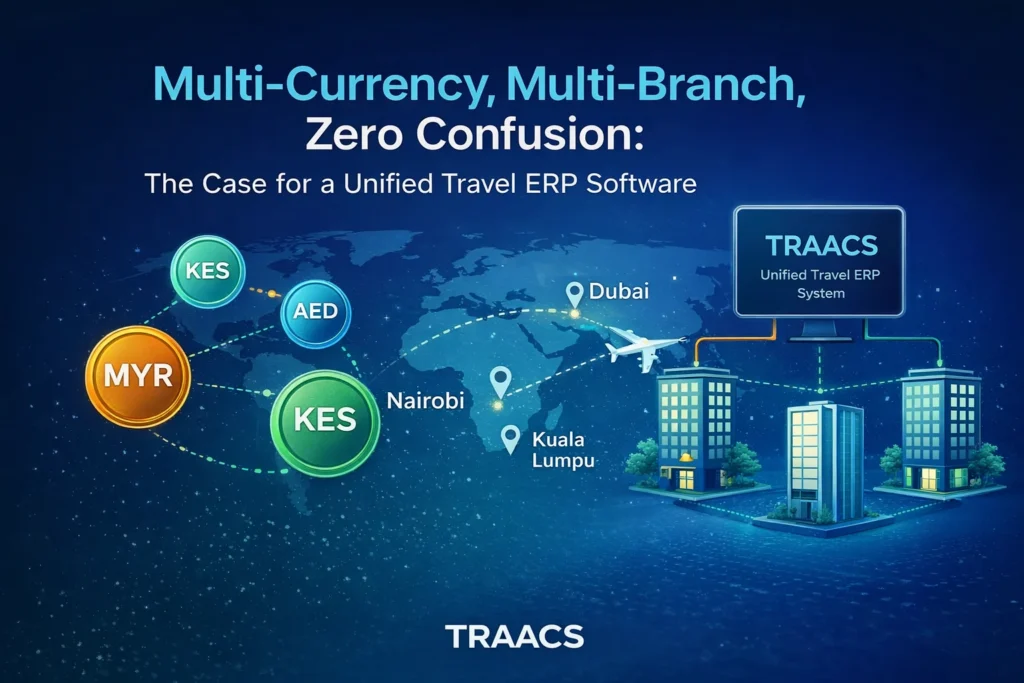
Picture a mid-sized travel agency with offices in Nairobi, Dubai, and Kuala Lumpur. Every morning, the finance team is reconciling invoices in Kenyan Shillings, UAE Dirhams, and Malaysian Ringgit – manually. A group booking from a corporate client crosses three branches, two currencies, and five suppliers. The branch manager in Dubai can’t see what Nairobi confirmed. The CEO in KL has no consolidated revenue view until Thursday.
This is not a failure of talent. It is a failure of systems.
The travel industry is one of the most financially complex sectors on earth. Agencies deal with thin margins, volatile exchange rates, real-time inventory, commission structures, supplier credit, multi-leg itineraries, and increasingly clients who expect instant digital service. Running this kind of operation on spreadsheets, disconnected booking tools, and patchwork accounting software is a recipe for errors, revenue leakage, and costly compliance failures.
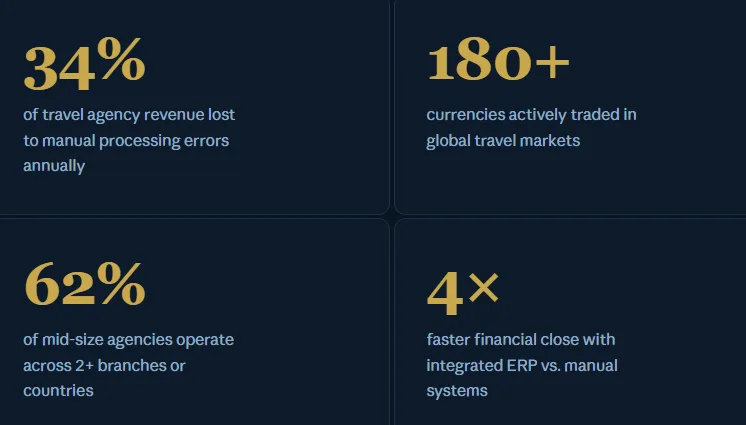
The solution is not more spreadsheets. It is not another standalone booking tool bolted onto a legacy accounting system. The solution is a purpose-built travel ERP software, a unified platform that connects every function of a modern travel agency into one coherent, real-time operational backbone.
What Is Travel ERP Software: and Why Does It Matter?
ERP stands for Enterprise Resource Planning. In most industries, ERP refers to integrated software that manages core business processes, such as finance, HR, inventory, procurement, and customer data, in a single system. Travel ERP software applies this principle specifically to the travel industry, adding the modules that agencies actually need: GDS connectivity, itinerary management, commission tracking, visa processing, BSP reconciliation, and multi-currency accounting.
Unlike generic ERP platforms adapted for travel (an expensive and often unsuccessful exercise), purpose-built ERP for travel agency operations understands the unique financial logic of the sector: mark-up vs. net-rate selling, credit vs. cash clients, deferred revenue recognition, and the reconciliation of booking confirmations against supplier invoices and BSP reports.
The right travel ERP system eliminates the need for an agency to run parallel systems, one for bookings, one for finance, one for CRM, and one for HR. Everything lives in a single database, updated in real time, accessible to authorized users across every branch and every time zone.
Multi-Currency Management: The Global Agency’s Biggest Challenge
Ask any finance director at a multi-national travel agency what keeps them awake at night, and the answer is almost always the same: currencies. Multi-currency management is the single greatest operational pain point for agencies working across regions, and it is where the gap between professional travel ERP software and improvised tooling becomes most dangerous.
The Real Cost of Currency Complexity
Consider the number of currency touchpoints in a single international group booking: the client pays in their local currency; the airline charges in USD; the hotel bills in local destination currency; the visa fees are collected in a third currency; the agency’s commission is calculated on a net rate in yet another currency. If each of these conversions is handled manually, with different exchange rates pulled from different sources at different times, the margin erosion can easily exceed the agency’s profit on the booking.
| Without ERP Multi-Currency Chaos | With ERP Multi-Currency Clarity |
| Exchange rates are pulled manually from different sources | Centralised rate management with live FX feed integration |
| Currency conversions done in spreadsheets, prone to formula errors | Currency conversions are done in spreadsheets, prone to formula errors |
| No real-time visibility into FX exposure | Real-time FX P&L visibility across all branches |
| Reconciliation takes days or weeks | Automated reconciliation on booking confirmation |
| Regulatory reporting is done currency-by-currency manually | Consolidated multi-currency statutory reporting |
| Revenue leakage from inconsistent rate application | Zero revenue leakage from inconsistent conversions |
Multi-Branch Operations Without the Confusion
Multi-branch travel agencies face a structural problem that no single-branch solution can solve: the need for simultaneous local autonomy and central visibility. Branch managers need to see and manage their own operations; headquarters needs consolidated, real-time data across every location. These two needs are in direct tension when agencies run branch-level systems that don’t talk to each other.
An erp system for travel agency networks resolves this by operating on a single shared database with role-based access. Branch A in Colombo cannot see Branch B’s client data in Lagos unless authorised — but the CFO in Riyadh can see everything, consolidated, in real time. Bookings made in one branch can be serviced by another. Supplier credit limits are visible across the network. Inventory – seats, rooms, packages- can be allocated, transferred, and managed centrally.
Branch-Level Control, Group-Level Visibility
The most sophisticated travel booking software for business networks enables what might be called “federated autonomy”: each branch operates with its own profit centre accounting, its own client ledger, its own booking workflow, but all data aggregates automatically to a group-level dashboard. No manual consolidation. No end-of-month scramble to collect figures from six countries. No discrepancies between what the branches report and what the accounting system shows.
The Multi-Branch ERP Advantage
When a travel group with branches across Southeast Asia implemented a unified travel ERP system, they reduced their month-end close from 14 days to 3 days, eliminated inter-branch reconciliation errors entirely, and for the first time gave their board real-time consolidated revenue visibility across all 9 branches — in a single dashboard, in their reporting currency.
For travel groups expanding regionally, opening in a new African market, adding a GCC satellite office, or acquiring an independent agency, the ability to onboard a new branch into an existing travel ERP software instance (rather than deploying an entirely new system) is a critical competitive and cost advantage.
Regional Context: Asia, Africa, the Middle East & Beyond
While the need for ERP travel management is global, the specific pressures vary significantly by region. Understanding these regional nuances is essential when evaluating any travel ERP system for your market.
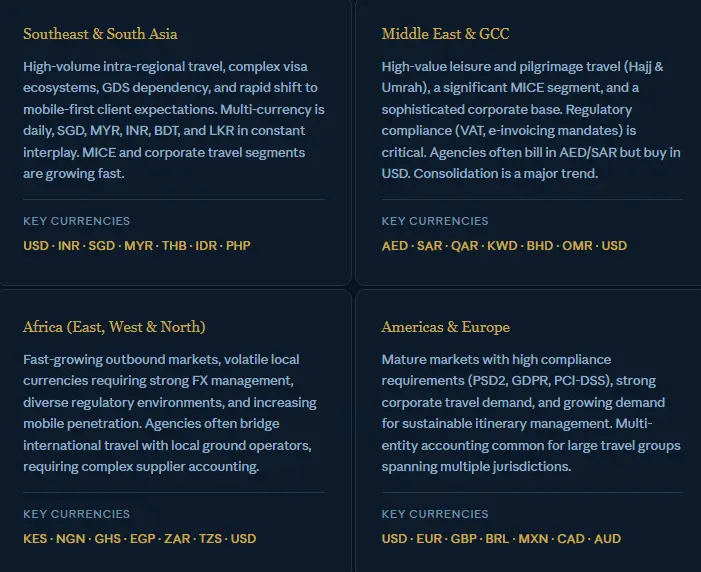
Agencies in all these regions share a common need: a travel ERP software that handles their local regulatory requirements without sacrificing the global connectivity their business depends on. Local tax codes, statutory chart of accounts, language support, and compliance with regional financial authorities (ZATCA in Saudi Arabia, FIRS in Nigeria, GST in India, VAT in the UAE) cannot be afterthoughts — they must be built into the system from the ground up.
What to Look for in a Travel ERP System
Not all platforms sold as travel management software are genuinely integrated ERP systems. Many are booking engines with accounting plugins, or accounting systems with booking modules, fundamentally different from a ground-up, unified architecture. When evaluating an erp system for travel agency operations, the following capabilities are non-negotiable.
| Capability | Why it Matters | Standalone Tools | Unifield ERP |
| Multi-Currency Accounting | Eliminates FX errors and revenue leakage | Manual or partial | Fully automated |
| GDS / Supplier Integration | Real-time inventory and booking confirmation | Separate system | Native integration |
| Multi-Branch Management | Consolidated control with branch autonomy | No consolidation | Real-time consolidation |
| Commission & Markup Tracking | Accurate margin per booking and per source | Manual calculation | Automated per booking |
| BSP Reconciliation | Accuracy in airline settlement and avoiding ADMs | Separate process | Automated matching |
| Client & Supplier Ledgers | Real-time credit management and supplier balances | Siloed per system | Unified real-time ledgers |
| Local Tax Compliance | VAT, GST, withholding tax per jurisdiction | Manual or workarounds | Configurable per entity |
| Real-Time Reporting | Operational and financial decisions without delay | Batch or manual exports | Live dashboards |
| CRM & Sales Pipeline | Client lifecycle from lead to repeat booking | Third-party CRM | Integrated CRM |
| HR & Payroll | Staff management aligned with operations | Separate HRMS | Fully integrated |
The key test is whether the platform shares a single database across all modules. If a booking created in the reservations module automatically generates a supplier payable, updates a client ledger, deducts from a credit limit, records in the functional currency, and appears in management reports, simultaneously, without manual intervention, that is genuine travel ERP software. Anything less is a collection of tools, not a system.
ERP for Small Travel Agencies: Scaling Without Suffering
A common misconception is that ERP is only for large enterprises. In reality, travel agency software for small businesses based on ERP principles is often more transformative for smaller agencies than for large ones, because smaller agencies have less tolerance for error, less capacity for manual processes, and more to gain from automation.
A small travel agency running three to ten staff, handling both leisure and corporate clients, and managing supplier relationships across multiple countries, faces the same complexity as a large agency, just with fewer people to manage it. Without the right travel booking software for business, the owner-manager becomes the system: memorising credit limits, manually calculating commissions, chasing supplier invoices by email, and producing financial reports from scratch each month.
Frequently Asked Questions
Travel ERP software is a unified enterprise platform that integrates all functions of a travel business, including reservations, accounting, CRM, supplier management, HR, and reporting into a single system. Regular booking software handles only reservations, requiring separate tools for finance and operations. The ERP advantage is a shared database: every transaction in any department is instantly visible to all authorised functions, in real time, with no manual data transfer.
These regions are characterised by high currency volatility, rapidly growing outbound travel volumes, complex regulatory environments, and agencies that frequently operate across borders. ERP travel management in these markets must handle multi-currency accounting, local tax compliance (VAT in the GCC, GST in India, various African tax authorities), and multi-branch consolidation simultaneously — requirements that generic or informal systems simply cannot meet reliably.
Multi-currency management in a travel ERP system works at three levels: transaction entry (every booking records the original transaction currency and amount), conversion (the system applies configured or live exchange rates to translate transactions into a functional currency), and reporting (all transactions consolidate into one or more reporting currencies for management and statutory accounts). This eliminates manual currency conversion, ensures consistent rate application, and enables real-time FX P&L visibility.
Absolutely. Modern cloud-based ERP system for travel agency operations, such as TRAACS , is designed to scale from small independent agencies to large multi-national networks. Small agencies benefit immediately from automation of manual processes (invoicing, reconciliation, commission calculation), professional reporting for corporate clients, and a scalable foundation for growth. The ROI is often faster for smaller agencies because the elimination of manual work has a proportionally larger impact.
TRAACS is recognized as one of the best travel ERP software solutions for agencies operating globally, particularly in Asia, Africa, and the Middle East. It offers comprehensive multi-currency and multi-branch management, GDS integration, BSP reconciliation, local tax compliance, CRM, and HR — all in a single unified platform purpose-built for travel agencies of all sizes.
Conclusion: Why TRAACS Is the Answer to Your Travel ERP Challenge
The travel industry’s complexity is not going away. If anything, as agencies expand into new markets, onboard more corporate clients, and navigate an increasingly demanding regulatory landscape, the operational demands will only intensify. The agencies that will thrive in Asia’s booming outbound markets, the Middle East’s premium travel segment, and Africa’s rapidly growing travel economy are those that build their operations on genuinely unified, purpose-built travel ERP software, not those that accumulate more point solutions and hope the spreadsheets hold.
Multi-currency, multi-branch, zero confusion is not an aspiration. It is a practical operational outcome, but only with the right system.
This is precisely where TRAACS stands apart. Built from the ground up as a complete travel ERP software platform – not an adapted generic ERP, not a booking engine with accounts bolted on – TRAACS delivers end-to-end integration across reservations, finance, CRM, HR, and operations in a single, unified system. Trusted by travel agencies across Asia, the Middle East, Africa, and globally, TRAACS offers:
- Comprehensive multi-currency management with real-time FX integration
- True multi-branch architecture with consolidated group-level reporting
- Travel booking software for business that integrates directly with GDS platforms
- Local tax compliance for GCC VAT, India GST, and African tax authorities
- Scalable travel agency software for small businesses through enterprise networks
- Real-time dashboards, automated BSP reconciliation, and full audit trails
If your travel agency is ready to move from operational complexity to operational clarity, from multi-currency confusion to multi-currency confidence, TRAACS is the travel ERP software built for exactly that journey.


