


There is a moment that almost every travel agency owner recognises. It is late on a Friday afternoon. A corporate client is requesting a detailed invoice breakdown across four currencies. The accounts manager is cross-referencing three spreadsheets, two email chains, and a handwritten notebook. The numbers do not match – and no one is sure which version is correct.
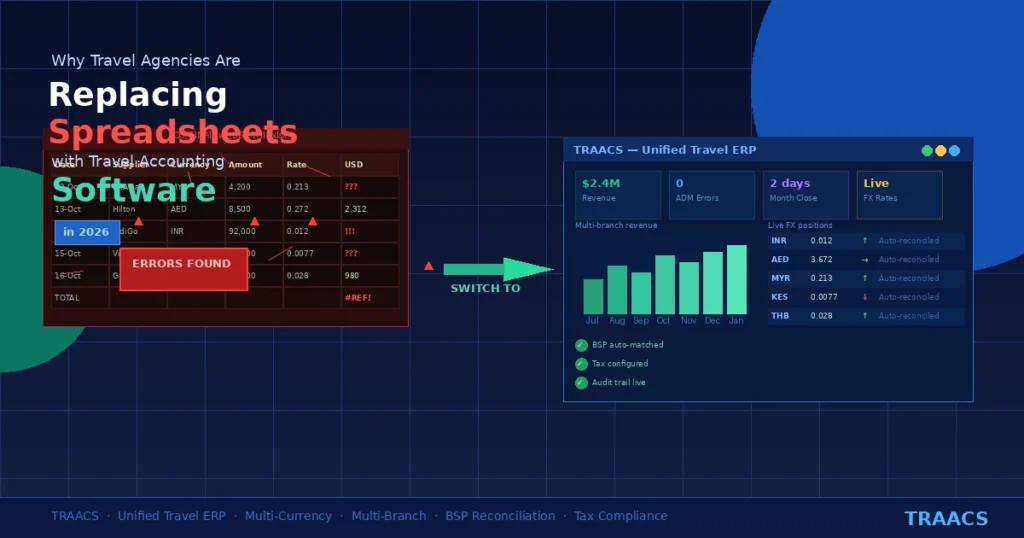
This is not a story about incompetence. It is a story about the wrong tool being used for an increasingly complex job. Spreadsheets were designed for general-purpose data organisation. Travel agency finance is anything but general-purpose.
In 2026, a growing number of travel businesses across Asia, the Middle East, and Africa are making a deliberate shift: away from manual, spreadsheet-based accounting and toward purpose-built travel accounting software. This blog unpacks exactly why – and what that shift looks like in practice.
The Scale of the Problem: What Spreadsheets Are Actually Costing You
Before examining the solution, it is worth understanding the real cost of the problem. Travel agencies operating on spreadsheets do not just face inconvenience – they face measurable, recurring financial and operational losses that compound over time.
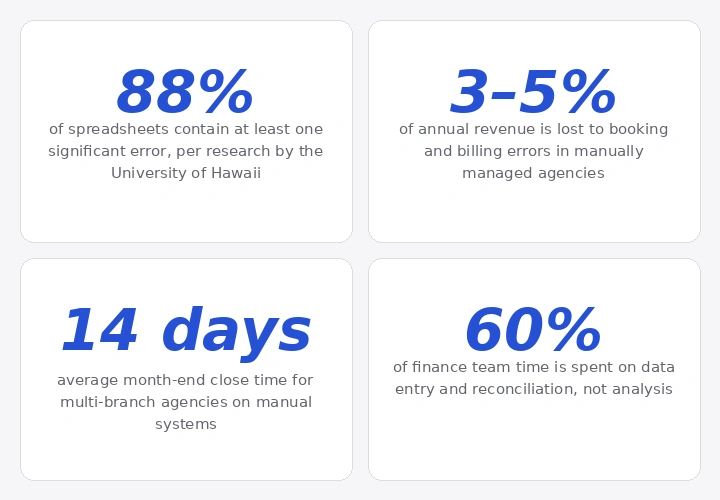
For a travel agency turning over $2 million annually, a 3% revenue leakage figure translates to $60,000 lost each year – money that disappears not in dramatic failures but in small, invisible ways: a commission miscalculated here, a currency conversion error there, a supplier invoice that slipped through the cracks.
Seven Reasons Travel Agencies Are Making the Switch in 2026
1. Multi-Currency Transactions Are Drowning Finance Teams
A single international group booking can involve a client paying in Indian Rupees, an airline charging in USD, a hotel billing in Thai Baht, and visa fees collected in yet another currency. When each of these conversions is handled manually in a spreadsheet, with rates pulled from different sources at different times, margin erosion is almost inevitable.
Modern travel accounting software handles multi-currency transactions automatically: applying live or configured exchange rates, recording each transaction in both functional and reporting currencies, and maintaining a real-time view of FX exposure across the business. What previously took a finance manager two hours of careful spreadsheet work is now handled at the point of booking, without manual intervention.
2. BSP Reconciliation Cannot Be Done Reliably by Hand
For IATA-accredited agencies, BSP reconciliation is a non-negotiable, high-stakes process. Errors result in ADMs (Agency Debit Memos), financial penalties from airlines that can be significant. Reconciling BSP reports against booking records manually, using exported data and spreadsheet formulas, is error-prone, slow, and stressful.
Travel accounting platforms built specifically for the industry automate BSP matching: each ticket sale is captured, matched against the BSP report, and flagged for review only when discrepancies are found. The result is faster reconciliation, fewer ADMs, and a complete audit trail that regulators can inspect without months of reconstruction work.
3. Multi-Branch Operations Cannot Be Consolidated Manually
For any travel agency operating more than one branch, whether across a city or across continents, spreadsheets create an impossible coordination problem. Each branch maintains its own records. Monthly consolidation requires collecting, formatting, and reconciling data from multiple sources. The process takes days, introduces errors, and produces a financial picture that is already outdated by the time it is ready.
A unified travel accounting system connects every branch to a single database. The CEO or CFO sees consolidated, real-time revenue across all locations without waiting for anyone to send them a file. Branch managers see their own data. Intercompany transactions are handled automatically. The month-end close that previously took 14 days can be done in 2 or 3 days.
| No Real-Time Visibility Spreadsheets show yesterday’s data at best. Management decisions are made on information that is already stale. | Version Control Chaos Multiple team members editing different copies of the same file creates conflicting records and accountability gaps. |
| Untracked Commission Leakage Manual commission calculations across suppliers, booking types, and markup structures are a consistent source of revenue loss. | Slow Month-End Close Finance teams spend weeks reconciling data that a proper accounting system would handle automatically, in real time. |
| Zero Audit Trail Spreadsheets have no built-in record of who changed what and when a serious compliance and accountability risk. | Tax Compliance Gaps Local tax rules – VAT, GST, withholding tax vary by jurisdiction and cannot be reliably managed through spreadsheet formulas. |
4. Corporate Clients Now Demand Instant, Accurate Reporting
The corporate travel segment in 2026 is more demanding than ever. Procurement managers and travel administrators expect instant access to booking summaries, cost-centre reports, policy compliance data, and invoice breakdowns, often in formats that integrate with their own ERP systems. Producing these reports from spreadsheets is not just slow; it is a competitive liability.
Travel accounting software generates these reports on demand, in the correct format, directly from live data. Agencies that can offer this level of reporting transparency tend to retain corporate accounts at significantly higher rates than those relying on manually assembled documents.
5. Supplier Credit Management Is a Daily Risk Without Automation
Every travel agency manages a web of supplier credit relationships: airlines, hotels, ground operators, visa services, and insurance providers. Each has credit limits, payment terms, and outstanding balances that change with every booking. Managing this in spreadsheets means someone is always manually tracking which supplier is approaching their limit, which invoices are overdue, and which payments need to be made today to avoid booking blocks.
With dedicated travel accounting software, supplier ledgers are updated automatically at the point of booking. Credit utilisation is visible in real time. Alerts fire before limits are breached. Payment runs can be planned with full visibility of what is due, when, and to whom, in the correct currency.
5. Supplier Credit Management Is a Daily Risk Without Automation
Every travel agency manages a web of supplier credit relationships: airlines, hotels, ground operators, visa services, and insurance providers. Each has credit limits, payment terms, and outstanding balances that change with every booking. Managing this in spreadsheets means someone is always manually tracking which supplier is approaching their limit, which invoices are overdue, and which payments need to be made today to avoid booking blocks.
With dedicated travel accounting software, supplier ledgers are updated automatically at the point of booking. Credit utilisation is visible in real time. Alerts fire before limits are breached. Payment runs can be planned with full visibility of what is due, when, and to whom, in the correct currency.
6. Local Tax Compliance Is Getting Stricter Across Key Markets
Travel agencies operating in the GCC face ZATCA e-invoicing mandates. Those in India navigate GST across multiple service types. Agencies across Africa deal with varying withholding tax and VAT frameworks. In 2026, regulatory compliance is not optional, and it cannot be managed through spreadsheet workarounds that do not understand local tax logic.
Purpose-built travel accounting software configures tax rules per entity, per transaction type, and per jurisdiction. Tax calculations are automatic. Compliance reports are generated without manual assembly. Audit-ready records exist by default, not as a last-minute scramble.
7. Growth Becomes Impossible at a Certain Scale
Perhaps the most important reason agencies are switching in 2026 is that spreadsheets are a ceiling, not a foundation. A two-person agency can manage spreadsheets. A fifteen-person agency with three branches, fifty suppliers, and a corporate client portfolio cannot – not without significant risk, not without burning out its finance team, and not without the kind of operational errors that damage client relationships and erode margins.
Travel accounting software is designed to grow with the agency. Adding a new branch, a new currency, a new supplier, or a new corporate client does not require rebuilding the system. It simply requires configuration, and the data flows automatically from day one.
Spreadsheets vs. Travel Accounting Software: A Direct Comparison
| Function | Spreadsheets | Travel Accounting Software |
| Multi-currency accounting | Manual rates, formula errors, FX losses | Automated conversion, live FX, no leakage |
| BSP reconciliation | Exported data, manual matching, ADM risk | Automated matching, instant exception alerts |
| Multi-branch consolidation | Manual file collection, 14+ day close | Real-time consolidated dashboard, 2–3 day close |
| Commission tracking | Calculated manually, often after the fact | Auto-calculated per booking, per source |
| Supplier credit management | Manually monitored, frequent oversights | Real-time ledgers, automated alerts |
| Corporate client reporting | Manually assembled, hours of work | On-demand, in multiple formats, from live data |
| Tax compliance (VAT/GST) | Workarounds are error-prone, and audit risk | Workarounds, error-prone, and audit risk |
| Audit trail | None – no record of who changed what | Complete, timestamped, tamper-evident |
| Scalability | Breaks down after a certain volume | Workarounds are error-prone, and audit risk |
What the Switch Actually Looks Like
One of the most common concerns travel agency owners raise when considering a move away from spreadsheets is disruption. Will the transition take months? Will the team need retraining? Will historical data be lost?
In practice, agencies that implement purpose-built travel accounting software like TRAACS report that the transition is significantly smoother than expected – particularly when the implementation partner has deep experience in travel-specific workflows. The typical pattern looks like this:
- Existing booking and financial data are migrated into the new system, with full historical records preserved
- Supplier and client ledgers are configured based on existing credit terms and account structures
- Multi-currency and tax rules are set up for each jurisdiction in which the agency operates
- Staff receive role-specific training, typically requiring just a few days rather than weeks
- The first month-end close in the new system typically takes less than half the time of the last spreadsheet-based close
- Real-time dashboards immediately eliminate the daily scramble for branch managers and finance heads
The agencies that find the transition hardest are usually those that have allowed their spreadsheet systems to become genuinely complex: multiple interconnected files, custom formulas built by one person who has since left, manual workarounds layered on top of workarounds. For these agencies, the transition is also the most valuable – because it replaces an invisible fragility with a robust, documented foundation.
Frequently Asked Questions
Not at all. Modern cloud-based travel accounting software is designed to scale from small independent agencies (3–5 staff) to large multi-national networks. In fact, smaller agencies often see the fastest return on investment, because the elimination of manual processes has a proportionally larger impact on a small team. A 3-person finance team freed from manual reconciliation effectively doubles its productive capacity overnight.
Yes – purpose-built travel accounting systems are designed to handle the full range of commission structures the industry uses: net-rate and mark-up selling, override commissions, segment-based incentives, BSP and non-BSP suppliers, and deferred payments. Unlike generic accounting software, travel-specific platforms understand that a single booking can involve multiple commission sources with different calculation methods and payment timing.
Implementation timelines vary based on agency size and complexity, but most mid-sized agencies complete the core implementation within 4 to 8 weeks. The critical factors are the quality of existing data (to be migrated), the number of branches and currencies to configure, and GDS integration requirements. Agencies with a clear implementation partner and a dedicated internal project lead consistently achieve faster go-lives.
Historical financial data – client ledgers, supplier accounts, booking records, and financial statements – is migrated into the new system as part of the implementation process. Reputable travel accounting software providers have established data migration processes that preserve the integrity of historical records. Most agencies choose a go-live date (often aligned with a financial year or quarter start) and migrate historical data up to that point, then run the new system forward from there.
This is precisely where purpose-built travel accounting software outperforms generic alternatives. Platforms like TRAACS are configured to handle GCC VAT (including ZATCA e-invoicing requirements in Saudi Arabia), India GST across multiple service categories, and various African tax frameworks. Each entity in the group can have its own tax configuration, while still consolidating into a unified group-level financial view in the reporting currency of choice.
Conclusion: The Spreadsheet Era in Travel Finance Is Ending
Conclusion: The Spreadsheet Era in Travel Finance Is Ending
Spreadsheets had a good run. For a generation of travel agency owners and finance managers, they were the best available tool for a job that required flexibility, familiarity, and zero software cost. In 2026, that calculation has fundamentally changed.
The complexity of modern travel agency finance, multi-currency, multi-branch, multi-supplier, multi-jurisdiction, has outgrown what any spreadsheet system can handle reliably at scale. The agencies still using spreadsheets are not just operating inefficiently; they are carrying invisible risks that will eventually surface as client relationship damage, regulatory exposure, or a competitor who can simply do things faster and more accurately.
The shift to dedicated travel accounting software is not a technology upgrade. It is a strategic decision about what kind of business you want to run – one where finance is a source of operational drag and anxiety, or one where it is a source of clarity, competitive advantage, and growth capacity.
For agencies across Asia, the Middle East, and Africa navigating this shift, TRAACS is purpose-built for exactly this transition: from the complexity of multi-currency accounting to the demands of multi-branch management, from BSP reconciliation to local tax compliance, all within a single unified platform designed from the ground up for travel agency operations.


