


In 2026, travel agencies are not asking whether they need an ERP. They already know they do. The question has shifted: which travel ERP software actually solves the problems we face every day and which just adds another layer of complexity to an already demanding operation?
The answer requires moving beyond feature lists. What agencies actually want from their ERP system for travel agency use in 2026 is a platform that thinks like a travel business: one that understands GDS billing cycles, IATA compliance pressure, multi-currency volatility, B2B agent complexity, and the relentless need for real-time financial visibility.
This article breaks down with specificity exactly what travel agencies worldwide are demanding from their travel management software in 2026, what separates the platforms that deliver from those that disappoint, and how TRAACS is built to meet each of those expectations.
The 2026 ERP Expectation Gap: What Has Changed
Three years ago, the bar for an ERP for travel agency operations was relatively straightforward: automate invoicing, connect to GDS, replace spreadsheets. Agencies that ticked those boxes felt ahead of the curve.
In 2026, that bar has shifted significantly.
Here is what has changed and why:
- Volume pressure: Agencies processing 200+ bookings per day cannot afford any manual touchpoint between booking confirmation and financial ledger. Every second of manual re-entry is a margin risk.
- Regulatory tightening: BSP compliance, IATA audit requirements, GST/VAT multi-jurisdiction reporting, and ADM exposure management have become board-level concerns not just finance team headaches.
- Real-time expectation: Agency owners and CFOs now expect the same real-time financial dashboards from their travel and expense management software that they see in consumer banking apps. Weekly reports are obsolete.
- AI-readiness: Forward-looking agencies want their ERP platform to support AI-powered forecasting, anomaly detection in reconciliations, and predictive revenue analytics not someday, but now.
- Integrated CRM pressure: With OTAs intensifying direct booking competition, agencies need travel CRM software built into their ERP not a disconnected add-on. Customer profiles, travel history, and automated retention workflows must be native.
The Seven Things Travel Agencies Actually Want in 2026
Auto-Accounting That Requires Zero Manual Entry
The single most consistent demand across agency sizes in 2026 is this: every booking must convert automatically into a fully reconciled financial record without a human touching it. This means:
- GDS booking imported → invoice auto-generated → ledger entry posted → BSP record matched → commission calculated — all within seconds of confirmation.
- LCC bookings, offline bookings, and manual services handled with equal automation.
- Credit notes, refunds, and reissuances auto-posted without manual journal entries.
This is what TRAACS calls Auto Accounting, a core engine that converts every booking event directly into accurate financial entries across the general ledger, accounts receivable, and commission tracking, in real time.
BSP Reconciliation That Closes in Hours, Not Days
For IATA-accredited agencies, BSP week is the most operationally stressful period of the month. Agencies with high ticket volumes particularly in the Middle East and South Asia are done manually reconciling BSP reports against internal booking records.
What they want in 2026 is automated BSP reconciliation that matches airline sales data against PNR records, flags ADM exposure before it escalates, handles RA (Refund Authorizations) automatically, and produces a clean remittance with zero manual intervention.
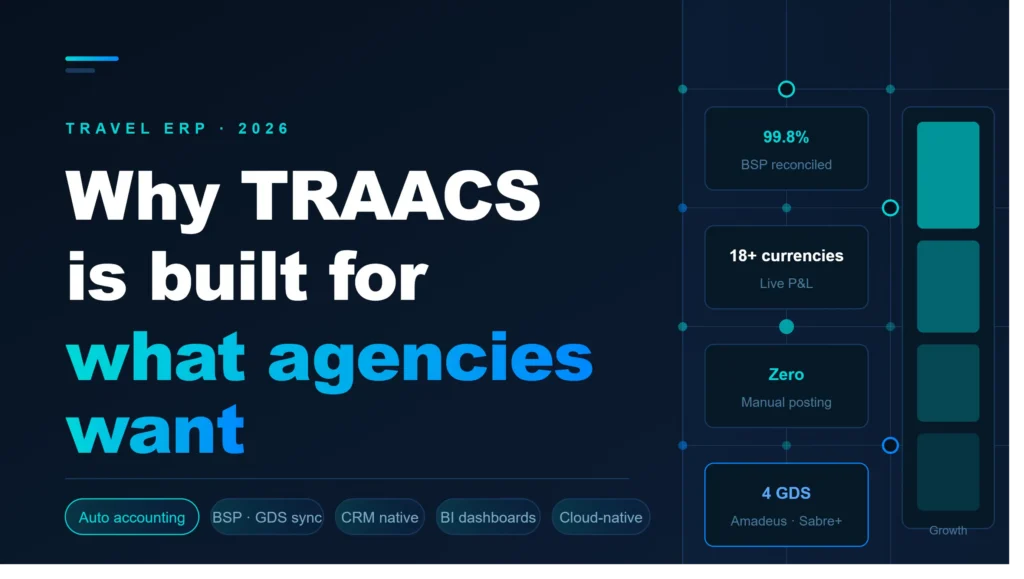
Note: Agencies using TRAACS auto-reconciliation report up to 60% reduction in ADM exposure and BSP close time cut from 3-4 days to under 4 hours. GDS data flows directly from Amadeus, Sabre, and Galileo into the reconciliation engine without manual export/import.
Real-Time Multi-Currency Financial Visibility
Agencies operating across multiple markets ticketing in USD, paying suppliers in EUR, reporting to ownership in AED or INR cannot afford currency conversion errors or delayed revaluation. In 2026, the demand is clear: travel and expense management software must handle multi-currency natively, not as a workaround.
This includes automatic exchange rate application at booking, end-of-day revaluation, live unrealised gain/loss reporting, and multi-currency P&L by branch. Agencies operating under a single set of consolidated accounts across multiple currencies need their ERP to produce IFRS-compliant multi-currency financial statements automatically.
B2B Agent Portal With Automated Markup and Credit Control
Wholesale agencies and tour operators running B2B distribution networks have a specific ERP requirement that generic travel management software consistently fails to meet: automated sub-agent management at scale.
What this means in practice:
- Sub-agents log into a branded B2B portal and see their contracted rates no back-office intervention needed.
- Markup rules applied automatically per agent tier, booking type, or supplier.
- Credit limits enforced in real time at GDS level agents cannot book beyond their credit exposure.
- Commission statements auto-generated and available in the agent portal.
- Booking volume reports by agent, product, and period available without manual data pulls.
This is not a CRM add-on. It is a core requirement of an ERP system for travel agency B2B operations in 2026.
Integrated Travel CRM Software – Not a Separate Tool
The market has spoken clearly: agencies are done paying for a separate travel CRM software tool that does not talk to their booking and finance systems. In 2026, CRM functionality must be native to the ERP.
Specifically, agencies want:
- Complete customer profiles: Travel history, passport details, preferences, loyalty tiers, and communication logs all accessible from the booking screen.
- Automated retention workflows: Pre-departure reminders, visa expiry alerts, post-trip follow-ups, and anniversary offers triggered automatically without agent involvement.
- Corporate account management: Per-client travel policy enforcement, spend reporting, and traveller profile management for TMCs handling corporate clients.
- Pipeline and lead tracking: Sales team visibility into group bookings, corporate RFPs, and MICE enquiries with conversion tracking.
When CRM and ERP data live in the same system, agencies eliminate the double-entry problem entirely: a booking creates a customer interaction record, a financial entry, and a commission calculation simultaneously.
BI Dashboards That Replace Manual Reporting
In 2026, agency management expects live dashboards not emailed Excel reports. The shift from weekly batch reporting to real-time business intelligence is not optional for competitive agencies. What they want from their travel ERP software:
- Revenue by branch, consultant, booking type, airline, and destination live.
- Margin analysis per booking, per agent, per corporate account.
- Outstanding receivables with aging updated in real time as payments are posted.
- Staff productivity KPIs: bookings per agent, revenue per consultant, conversion rates.
- Unused ticket tracker monitoring open tickets for up to 12 months for timely refunds.
This level of BI capability is not a premium feature in 2026. It is the baseline expectation for any serious ERP for travel agency management.
Scalability Without Re-Implementation
One of the most consistent complaints agencies have about their current ERP platforms: the moment they grow adding branches, onboarding sub-agents, expanding into new markets — the system either slows down or requires expensive re-implementation.
The 2026 requirement is a cloud-native travel management software architecture that scales horizontally: adding a new branch takes a configuration change, not a new installation. Adding a new currency takes a rate feed, not a development sprint.
How Travel ERP Platforms Compare on 2026 Agency Priorities
| Agency Priority | Generic ERP (SAP/Oracle) | Standalone Agency Software | TRAACS Travel ERP |
|---|---|---|---|
| Auto-Accounting (GDS→Ledger) | Manual mapping required | Partial — invoicing only | Full auto-accounting, real-time |
| BSP Reconciliation | Not supported natively | Manual or semi-automated | Fully automated, ADM alerts |
| Multi-Currency P&L | Available but complex setup | Basic | Native – auto revaluation |
| B2B Agent Portal | Not travel-specific | Limited | Full portal with credit control |
| Integrated Travel CRM | Separate module | Not available | Native CRM – booking integrated |
| Real-Time BI Dashboards | Available – expensive add-on | Basic reports only | Live dashboards + Travtics BI |
| GDS Integration Depth | API – manual | Varies | Native: Amadeus, Sabre, Galileo |
| Unused Ticket Tracking | Not available | Not available | Automated – up to 12 months |
| Cloud-Native Scalability | Yes – expensive | Limited | Yes – multi-branch, multi-entity |
What Agencies Get Wrong When Evaluating ERP Software
After implementing travel ERP systems across hundreds of agencies, several evaluation mistakes appear repeatedly:
- Evaluating features instead of workflows. A feature list tells you what a system can do. A workflow demonstration tells you how it handles your specific booking-to-cash cycle. Always test with your own real booking scenarios.
- Underestimating data migration. Historical booking data, customer records, and supplier contracts need migration. Agencies that skip a formal data audit 60-90 days before go-live face delayed go-live dates and data integrity issues.
- Choosing on price alone. The cost of a wrong ERP implementation in lost productivity, reconciliation errors, and staff frustration far exceeds any savings from choosing the cheapest option.
- Ignoring BSP and GDS integration depth. Many travel management software platforms offer GDS ‘connectivity’ via file imports. In 2026, native real-time GDS integration is non-negotiable for agencies processing meaningful ticket volumes.
- Skipping the finance team in demos. ERP buying decisions driven exclusively by operations teams often overlook the auto-accounting, reconciliation, and compliance requirements that make the finance team’s month-end bearable. Include your CFO and senior accountant in every demo.
5. Frequently Asked Questions – What Agencies Ask in 2026
In 2026, a travel agency needs an ERP that automates the entire booking-to-cash workflow without manual intervention from GDS import through invoicing, BSP reconciliation, commission calculation, and financial reporting. It must include native travel CRM software, real-time multi-currency dashboards, B2B agent portal management, and scalable cloud architecture. Generic ERPs like SAP or Oracle do not meet these travel-specific requirements out of the box.
Travel management software typically refers to front-end booking and itinerary tools. A travel ERP system for travel agency operations goes deeper integrating booking management with back-office accounting, BSP reconciliation, payroll, CRM, supplier management, and BI reporting in a single unified platform. TRAACS is a full travel ERP, not just booking or accounting software.
Travel and expense management software built into a travel ERP automates the tracking of bookings, expenses, supplier payments, and staff costs in a single system. For TMCs managing corporate clients, it enables per-client expense reporting, travel policy enforcement, and consolidated billing eliminating the need for separate expense management tools that don’t communicate with the booking system.
BSP (Billing and Settlement Plan) reconciliation is the process of matching an IATA-accredited travel agency’s airline ticket sales against the BSP report issued by IATA, ensuring financial accuracy before settlement. Errors in BSP reconciliation result in ADMs (Agency Debit Memos) financial penalties issued by airlines. An automated ERP like TRAACS performs BSP reconciliation in real time, reducing ADM exposure by up to 60% and cutting reconciliation time from days to hours.
Any travel agency processing more than 50 bookings per day, operating across multiple branches or currencies, managing B2B agent networks, or handling corporate travel accounts will see significant ROI from a travel ERP. The threshold for ROI on travel ERP implementation has dropped significantly in 2026 due to cloud-native pricing models agencies that once considered ERP too expensive now deploy within their operating budgets.
Why TRAACS Is Built for What Agencies Want in 2026
TRAACS by Nucore Software Solutions is a purpose-built travel ERP software platform not a generic ERP adapted for travel, and not a standalone booking tool with accounting bolted on. It was architected from the ground up to solve the specific operational and financial challenges that travel agencies face.
Here is how TRAACS directly addresses each 2026 agency priority:
- Auto Accounting Engine: Every booking GDS, LCC, offline, or manual converts automatically into ledger entries, invoices, and financial reports. Zero manual journal posting.
- Native BSP & GDS Reconciliation: Real-time integration with Amadeus, Sabre, Galileo, and Travelport. BSP auto-match, ADM tracking, RA handling, and unused ticket monitoring all automated.
- Multi-Currency P&L: Automatic exchange rate application, end-of-day revaluation, and live multi-currency balance sheets across branches and entities.
- B2B Agent Portal: Branded self-service portal for sub-agents with real-time credit control enforced at GDS level. Markup rules, commission statements, and booking reports fully automated.
- Integrated Travel CRM Software: Complete customer profiles, corporate account management, automated retention workflows, and pipeline tracking native to the booking and finance system.
- Travtics BI Integration: Live dashboards for revenue, margins, branch performance, staff KPIs, and receivables accessible on desktop and mobile.
- Cloud-Native Architecture: Multi-branch, multi-entity, multi-currency add new branches and agents without re-implementation. Scale with confidence.
Conclusion: The ERP That Thinks Like a Travel Business
What travel agencies actually want from their ERP in 2026 is not revolutionary it is specific. They want automation that eliminates every manual touchpoint between booking and bank. They want BSP compliance without a team of accountants. They want real-time visibility without waiting for reports. They want a travel CRM software that is part of the same system as their finance and booking tools. They want to scale without starting over.
TRAACS is built to deliver exactly that. As a fully integrated travel ERP software, travel management software, and travel CRM software platform, TRAACS connects every dimension of a travel agency’s operation bookings, finance, compliance, customer relationships, and business intelligence in one unified system that scales with your business.
If your agency is still running on disconnected tools, manual reconciliations, or a generic ERP that was never built for travel 2026 is the year that gap starts costing you more than the investment required to close it.


